

How a Roth Conversion Can Raise Your Medicare Premiums Two Years Later
You did the math on a Roth conversion and it made sense. Move some money out of the traditional IRA now, pay the tax at today's rates, and take the future growth out tax-free. Your tax preparer agreed the numbers worked.
Then, two years later, a letter arrives from Social Security saying your Medicare premium is going up. Not by a few dollars. By a few hundred a month, for you and your spouse together, for the whole year.
Nothing about your life changed. Your income that year is the same as it was. The letter is reaching back to a tax return you filed two years ago — the one with the conversion on it.
Key Takeaways
Medicare sets your Part B and Part D premiums using a tax return from two years earlier, so your 2026 premiums are based on what you reported for tax year 2024.
A Roth conversion counts as ordinary income in the year you do it, which raises the modified adjusted gross income figure Medicare looks at — even though no new money came into your household.
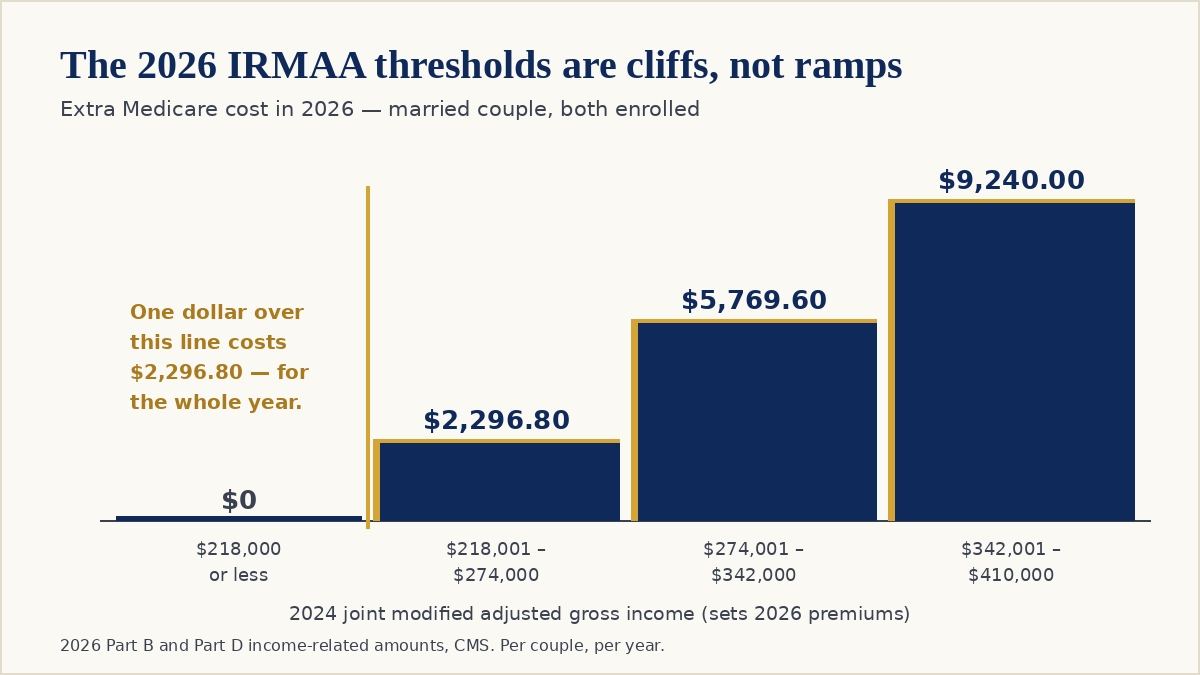
The 2026 income thresholds are cliffs, not ramps. Going one dollar over a line costs the same as going eighteen thousand dollars over it.
A couple who crossed the first 2026 threshold pays $2,296.80 more across the year in combined Part B and Part D surcharges than a couple who stayed just under it. [1]
A Roth conversion is not on Social Security's list of life-changing events, so you generally cannot appeal the surcharge away after the fact.
What IRMAA is, and why it looks at a two-year-old tax return
Most people on Medicare pay the standard Part B premium, which is $202.90 a month in 2026. The annual Part B deductible is $283. Those figures come from the Centers for Medicare & Medicaid Services and change every year. [1][5]
People above certain income levels pay more. The extra amount is called the income-related monthly adjustment amount, or IRMAA. It applies to Part B and, separately, to Part D prescription drug coverage. It is not a tax and it is not means-testing in the usual sense — it is an addition to your premium, billed monthly, usually deducted straight from your Social Security payment.
Here is the part that catches people. Social Security doesn't know what you earned this year, because you haven't filed that return yet. So it uses the most recent return the IRS has handed over. In its own words, to set 2026 amounts it uses "your most recent federal tax return the IRS provides to us," which is "generally... from a tax return filed in 2025 for tax year 2024." [3]
That is the two-year lookback. Your 2026 premium is a function of your 2024 income. A decision you made in 2024 shows up in your mailbox in late 2025 and is charged to you all through 2026.
The figure Medicare uses is modified adjusted gross income — which Social Security defines as "your total adjusted gross income and tax-exempt interest income." [3] Note that second part. Municipal bond interest that is exempt from income tax is added back in for this purpose. So is the taxable portion of Social Security, capital gains, dividends, pension income, and IRA withdrawals.
Why a Roth conversion lands you there
When you convert money from a traditional IRA to a Roth IRA, the converted amount is treated as ordinary income in that tax year. That is the deal: you're paying the tax you deferred, at the rates in effect now, in exchange for tax-free treatment later.
The tax bill is the part people plan for. The part that gets missed is that the conversion also lands in your adjusted gross income — and therefore in the MAGI figure Medicare uses two years later.
This is what makes conversions different from most other retirement moves. You didn't spend anything. No new money arrived in your checking account. You moved your own savings from one bucket to another and paid tax for the privilege. But as far as the IRMAA calculation is concerned, that year you had a large income, and your Medicare premiums two years later are set accordingly.
It is also, for many people, a one-year event. You convert in one year, absorb the surcharge in the year two years later, and then it drops back off — because the following year's return doesn't have a conversion on it. That's genuinely worth knowing. The surcharge is usually temporary, not permanent. But it is real money in the year it lands.
The 2026 thresholds — and why they are cliffs
Here are the 2026 Part B figures, straight from the CMS fact sheet. [1]
MAGI — individual | MAGI — married filing jointly | Part B surcharge | Total Part B premium |
|---|---|---|---|
$109,000 or less | $218,000 or less | $0.00 | $202.90 |
$109,001 – $137,000 | $218,001 – $274,000 | $81.20 | $284.10 |
$137,001 – $171,000 | $274,001 – $342,000 | $202.90 | $405.80 |
$171,001 – $205,000 | $342,001 – $410,000 | $324.60 | $527.50 |
$205,001 – $499,999 | $410,001 – $749,999 | $446.30 | $649.20 |
$500,000 or more | $750,000 or more | $487.00 | $689.90 |
And the Part D surcharge, which sits on top of whatever your drug plan's own premium is: [1]
MAGI — individual | MAGI — married filing jointly | Part D surcharge |
|---|---|---|
$109,000 or less | $218,000 or less | $0.00 |
$109,001 – $137,000 | $218,001 – $274,000 | $14.50 |
$137,001 – $171,000 | $274,001 – $342,000 | $37.50 |
$171,001 – $205,000 | $342,001 – $410,000 | $60.40 |
$205,001 – $499,999 | $410,001 – $749,999 | $83.30 |
$500,000 or more | $750,000 or more | $91.00 |
Two things about these tables matter more than the numbers themselves.
First, they are per person. If both spouses are on Medicare, both pay the surcharge, based on the same joint MAGI figure. Every number above doubles for a couple.
Second, there is no phase-in. Income tax brackets are marginal — cross into the 24% bracket and only the dollars above the line are taxed at 24%. IRMAA does not work that way. Cross the line by one dollar and you pay the entire tier's surcharge for all twelve months. This is why conversion planning around IRMAA is unusually sensitive to the last few thousand dollars.
A worked example: what the last $19,000 cost
Dave and Karen are both 67, both on Medicare, both retired. In 2024 their income — Social Security, a small pension, and interest — put their MAGI at $96,000.
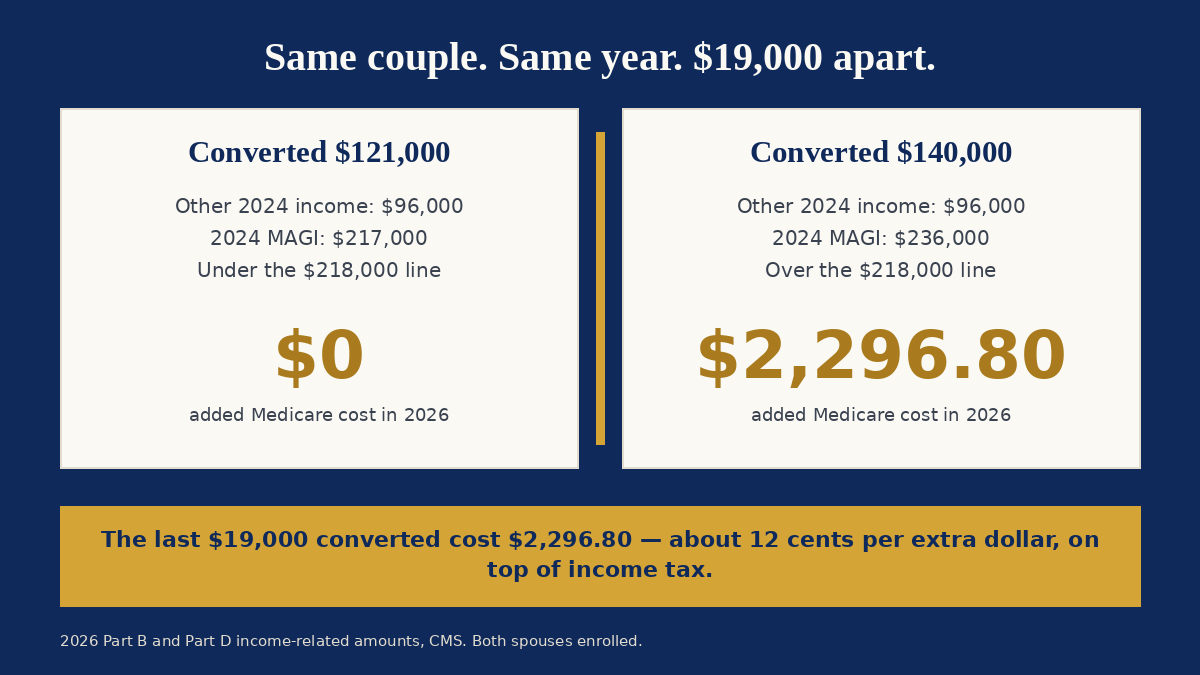
That year they converted $140,000 from Dave's traditional IRA to a Roth. Their 2024 MAGI became $236,000.
That figure lands in the first joint tier, above $218,000. So in 2026:
Part B: $81.20 extra per month, each. That's $162.40 a month for the couple, or $1,948.80 for the year. [1]
Part D: $14.50 extra per month, each. That's $29.00 a month for the couple, or $348.00 for the year. [1]
Total: $2,296.80 in surcharges across 2026 — on top of the federal income tax the conversion generated back in 2024.
Now run it the other way. Had they converted $121,000 instead, their 2024 MAGI would have been $217,000 — just under the line. Their 2026 surcharge would have been zero.
So the last $19,000 of that conversion carried an extra $2,296.80 in Medicare cost. That's roughly 12 cents of Medicare surcharge for every additional dollar converted in that final slice, entirely separate from the income tax on it.
And because the threshold is a cliff, the same $2,296.80 would have been owed if they had gone over by a single dollar.
None of this means the conversion was a mistake. It might still have been the right call across a twenty-year horizon — a surcharge in one year can be small next to decades of tax-free growth, and only your own numbers can settle that. The point is narrower: the surcharge is a real cost that belongs in the comparison, and most conversion math leaves it out.
Size it for your own situation. The Medicare IRMAA calculator shows which tier a given MAGI lands in and what the surcharge comes to for one person or a couple. The Roth Conversion Explorer on the same page lets you test conversion amounts against your other income. Running one before the other is how people find the line before they cross it.
The tax bracket line and the IRMAA line are not the same line
A common approach to conversions is "fill the bracket" — convert exactly enough to reach the top of your current tax bracket and no further. It's sound reasoning on its own terms. It also quietly walks people into an IRMAA tier, because the two lines are measured differently and sit in different places.
For tax year 2026, the 22% bracket for a married couple filing jointly runs up to $211,400 of taxable income, with the 24% bracket beginning above that. The 2026 standard deduction for that couple is $32,200. [6]
Taxable income is what's left after deductions. MAGI is measured before them. So a couple who converts exactly enough to reach the top of the 22% bracket — $211,400 in taxable income — is sitting at roughly $243,600 of adjusted gross income.
That is well inside the first joint IRMAA tier, which starts at $218,001. Filled the bracket perfectly; bought the surcharge anyway.
The gap is wider still for people 65 and older, who may claim additional deductions that reduce taxable income without reducing AGI at all. Every dollar of deduction widens the distance between the number your tax software is optimizing and the number Medicare is watching.
If you take one mechanical thing from this article, make it that: IRMAA is measured on income before deductions, income tax on income after them. They are not interchangeable, and a plan built around one can miss the other entirely.
What you can appeal, and what you can't
Social Security will reconsider an IRMAA determination if a qualifying life-changing event has reduced your income. You report it on Form SSA-44, officially titled Medicare Income-Related Monthly Adjustment Amount — Life-Changing Event. [4]
The form lists eight qualifying events: [4]
Marriage
Divorce or annulment
Death of your spouse
Work stoppage
Work reduction
Loss of income-producing property
Loss of pension income
Employer settlement payment
Look at that list carefully. A Roth conversion is not on it. Neither is a capital gain, an inherited IRA distribution, a one-time bonus, or the sale of a house or a business.
This is the part people find hardest to accept. The surcharge is not a penalty for doing something wrong and there is no hardship provision for having voluntarily raised your own income. If the income was real and the event isn't on the list, the surcharge generally stands.
What SSA-44 is actually for is the opposite situation: your income genuinely dropped and the old return no longer reflects reality — you retired, your hours were cut, your spouse died. In those cases you submit the form with proof of the event and either a signed return or an IRS transcript for the more recent year, and Social Security recalculates.
Separately, if the figure Social Security used is simply wrong — an amended return, an IRS transmission error — that's a different process and worth raising directly with Social Security rather than through SSA-44.
The part nobody can calculate yet
Here is an honest limit on any conversion planning done right now.
A conversion completed in 2026 affects your 2028 Medicare premiums. The 2028 thresholds and surcharge amounts have not been published. CMS announces each year's figures in the autumn of the preceding year — the 2026 numbers in this article were released in November 2025. [1][2]
So anyone converting in 2026 with an IRMAA target in mind is aiming at lines that don't exist yet. The thresholds have generally moved with inflation in recent years, which makes the current table a reasonable proxy, but it is a proxy and not a rule.
One known wrinkle: the Federal Register notice setting the 2026 Part B rates states that the top-tier thresholds established by the Bipartisan Budget Act of 2018 — the $500,000 individual and $750,000 joint levels — are to be inflation-adjusted only beginning in 2028. [2] Those particular lines have been fixed while the ones beneath them moved.
The practical consequence is about margin. Planning to land exactly one dollar under a threshold that won't be published for another two years leaves you no room for a larger-than-expected dividend, a mutual fund capital gain distribution in December, or an interest rate that ran higher than you assumed.
Before you commit to a number, it's worth seeing where your current income already sits relative to the thresholds. The Medicare IRMAA and Roth Conversion calculators will show you your headroom — how much room is left beneath the next line before a conversion uses it up.
Frequently asked questions
If I convert this year, when exactly does the higher premium hit?
Two years later. A conversion in tax year 2026 shows up on the return you file in 2027, which Social Security uses to set your 2028 premiums. You'd typically get the notice in late 2027.
Does the surcharge stay on forever?
Generally no. IRMAA is recalculated every year from the most recent return available. If the conversion was a one-year event, the surcharge normally applies for one year and then falls away as a return without the conversion comes into use.
My spouse isn't on Medicare yet. Do we still get hit twice?
No. The surcharge is billed per enrolled person, but it's determined by your joint MAGI. If only one of you is enrolled, only one surcharge is billed — though it's still calculated from the household's joint income.
Can I spread a conversion over several years to stay under the threshold?
Converting smaller amounts across multiple years is how some people keep each year's MAGI below a line. The trade-offs are that you're exposed to whatever tax rates and thresholds exist in those later years, the money stays in the traditional IRA longer, and future required minimum distributions keep accruing on the balance you haven't converted. Whether that trade favors you depends on your balances, your other income, your time horizon, and your tax situation.
Does tax-exempt municipal bond interest really count?
Yes. Social Security defines the MAGI it uses as adjusted gross income plus tax-exempt interest income. [3] Interest that is invisible on your tax bill is visible to this calculation.
What if my income dropped because I retired — can I do anything?
Yes, this is exactly what Form SSA-44 exists for. Work stoppage and work reduction are both on the qualifying list. [4] You submit the form with documentation of the event and evidence of your more recent income, and Social Security can use the newer figure instead of the two-year-old return.
Source Links
Every figure in this article comes from one of the government sources below. The small numbers throughout the text show which one, so you can check any figure yourself rather than taking our word for it. All were current as of 17 September 2026; Medicare and tax figures change annually.
1. Centers for Medicare & Medicaid Services — 2026 Medicare Parts A & B Premiums and Deductibles
The $202.90 standard Part B premium, the $283 deductible, and the complete 2026 Part B and Part D income-related adjustment tables. Every threshold and surcharge figure in this article traces here.
2. Federal Register — Medicare Program; Medicare Part B Monthly Actuarial Rates, Premium Rates, and Annual Deductible Beginning January 1, 2026
The official rate-setting notice, published 19 November 2025 — which is where the autumn-announcement timing comes from — and the statement that the top-tier thresholds set by the Bipartisan Budget Act of 2018 are inflation-adjusted only from 2028.
3. Social Security Administration — Medicare premiums
The two-year lookback in SSA's own words, and its definition of the modified adjusted gross income it uses: adjusted gross income plus tax-exempt interest income.
4. Social Security Administration — Form SSA-44, Medicare Income-Related Monthly Adjustment Amount — Life-Changing Event
The form itself: its official title, the eight qualifying life-changing events, and the documentation it asks for.
5. Medicare.gov — Medicare costs
The 2026 Part B premium and deductible, confirming the CMS figures on the consumer-facing site.
6. Internal Revenue Service — IRS releases tax inflation adjustments for tax year 2026
The 2026 federal tax brackets and standard deduction — the $211,400 top of the 22% bracket and the $32,200 joint standard deduction used in the bracket comparison.
Annuity HQ publishes retirement education. This article explains how a rule works; it is not advice, and it does not recommend a course of action. Individual circumstances differ, and tax and Medicare rules change annually. Figures cited apply to the years stated.
 | Jack Whittaker Jack writes the retirement education material at Annuity HQ from Mooresville, North Carolina, drawing on four decades of work with people making income, tax and Medicare decisions at retirement. |
