
When a Roth Conversion Actually Pays Off: Running the Break-Even
"Convert now and pay the tax at today's rates" is the sentence almost every article about Roth conversions is built around. It sounds obviously right. Rates are low, the reasoning goes, so use them.
But whether a conversion actually leaves a household with more money is arithmetic, not a slogan. It turns on a short list of things you can write down: the rate you would pay on the conversion today, the rate that same money would be taxed at later, where the cash for the tax bill comes from, and how many years the account has left to grow.
What follows is that arithmetic, worked through with real 2026 figures. One of those four levers turns out not to matter at all — and which one it is depends entirely on how you pay the tax.
Key Takeaways
If you pay the conversion tax out of the IRA itself, the break-even reduces to a single comparison: is your future tax rate higher than the rate you pay today? The growth rate and the number of years cancel out of the math completely.
If you pay the tax from outside savings, the conversion shelters that money too, and the break-even drops. In the worked example below it falls from 15.4% to 12.4%.
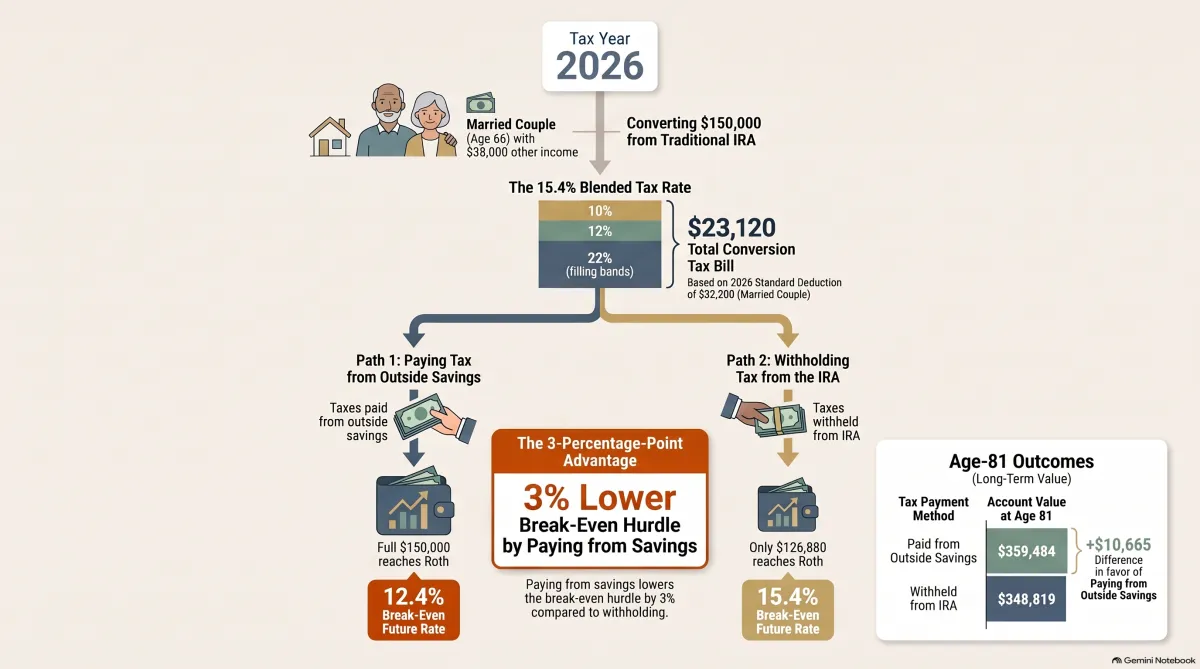
A conversion is not taxed at your top bracket. The example converts $150,000 with a top bracket of 22% and pays a blended 15.4%, because the money fills the 10% and 12% bands on the way up. [1]
Conversions made in 2018 or later cannot be recharacterized — the IRS's word for undone — so the arithmetic has to be right before the return is filed. [2]
The two things that most often push a household's future rate up are required minimum distributions, which begin at age 73, and a surviving spouse filing single on brackets roughly half as wide. [3][1]
What a break-even actually compares
A Roth conversion moves money out of a traditional IRA and into a Roth IRA. The amount converted is included in income for that tax year and taxed as ordinary income. [2] In exchange, that money and everything it earns afterwards come out tax-free, provided the distribution is qualified — which for most people over 59½ means the Roth has been open for at least five tax years. [4]
So the comparison is between two futures for the same dollars. In one, the money stays in the traditional IRA, grows, and is taxed whenever it comes out. In the other, the tax is paid now and the money grows untaxed.
Here is the part that surprises people. If the tax is paid out of the conversion itself — that is, you convert $150,000 and have the custodian withhold the tax from it — then the growth rate and the time horizon drop out of the comparison entirely. It doesn't matter whether the account earns 3% or 9%, or whether you're looking ahead five years or twenty-five. Both sides grow by exactly the same multiple, so it cancels.
What's left is one question: is the rate that money would be taxed at later higher than the rate you pay on it today? If yes, converting comes out ahead. If no, it doesn't. Nothing else moves the needle.
That changes the moment the tax bill is paid from somewhere else, and that is the second half of this article.
Your conversion is not taxed at one rate
Before any of that, there is a smaller point that a lot of conversion planning gets wrong: the rate you pay on a conversion is almost never your top bracket.
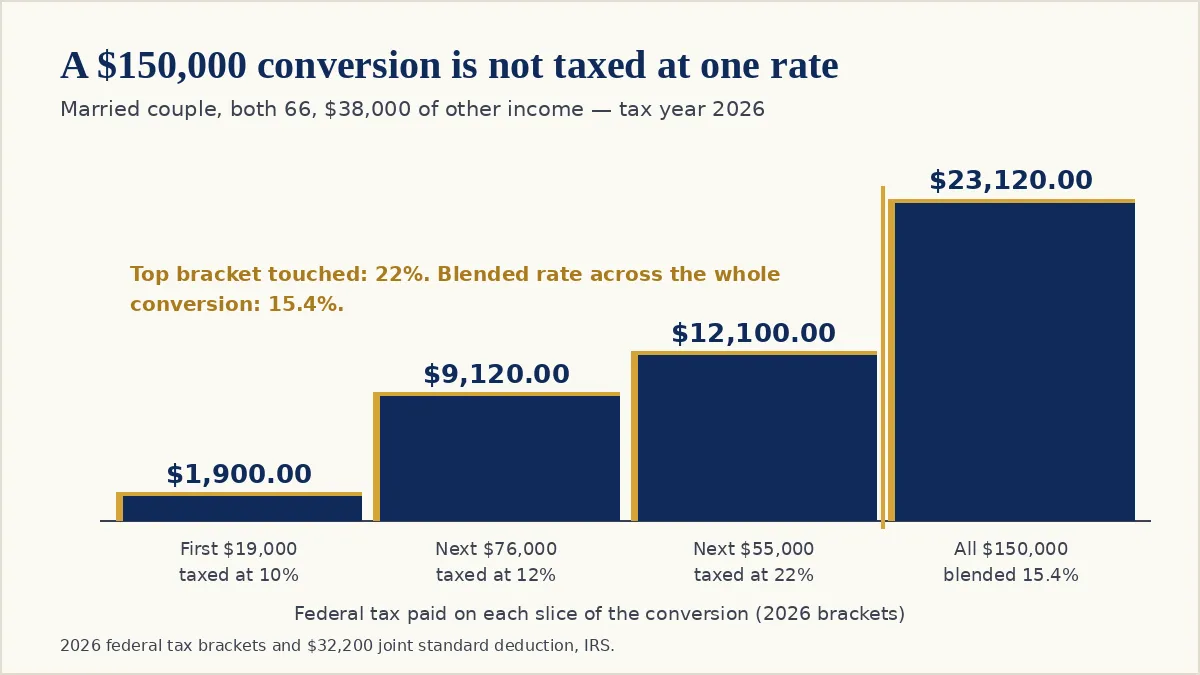
Income tax brackets are marginal. A conversion stacks on top of whatever taxable income you already have and fills each band in turn. So a conversion that reaches into the 22% bracket has also passed through the 10% and 12% bands, and the blended rate across the whole conversion is lower than the top one it touches.
For tax year 2026, a married couple filing jointly pays 10% on the first $24,800 of taxable income, 12% from there to $100,800, 22% to $211,400, and 24% to $403,550. The 2026 standard deduction for that couple is $32,200. [1]
Those are the figures the worked example runs on. Note the year — brackets and the standard deduction are adjusted annually, so a break-even run in 2027 uses a different set.
Bill and Marie: running the numbers
Bill and Marie are both 66. They retired last year, neither has claimed Social Security yet, and they are living off a taxable brokerage account. Their other income for 2026 — a small pension, interest and dividends — comes to $38,000. Bill's traditional IRA holds $600,000.
Against the 2026 standard deduction of $32,200, their taxable income before any conversion is $5,800, which sits in the 10% bracket. [1]
They convert $150,000. That lifts their 2026 taxable income to $155,800, and it fills the brackets like this: [1]
The first $19,000 finishes off the 10% band — $1,900 of tax
The next $76,000 runs through the 12% band — $9,120
The last $55,000 lands in the 22% band — $12,100
Total federal tax on the conversion: $23,120. Across the whole $150,000 that is a blended rate of 15.4%, not the 22% their top bracket would suggest.
Now the break-even. Assume the money grows at 6% a year for 15 years, to age 81, and that money left in the brokerage account grows at 4.5% a year after the tax drag on its dividends and gains. Both of those are assumptions, not facts — change them and the numbers change, which is the point of running your own.
At age 81, here is what the household has left after all tax, under three choices made at 66:
Their future tax rate | Don't convert | Convert, tax paid from savings | Convert, tax withheld from the IRA |
|---|---|---|---|
10% | $368,279 | $359,484 | $348,819 |
12% | $361,089 | $359,484 | $348,819 |
12.4% | $359,484 | $359,484 | $348,819 |
15.4% | $348,819 | $359,484 | $348,819 |
22% | $325,141 | $359,484 | $348,819 |
24% | $317,951 | $359,484 | $348,819 |
The two bolded rates in the left column are the break-even points. Below them, not converting wins. Above them, converting wins. And they are not the same number, because the two conversion columns differ in one respect only: where the $23,120 came from.
Size it for your own situation. The Roth Conversion Explorer takes your own IRA balance, your other income and the conversion amount you're considering, and shows the blended rate you'd actually pay and the future rate at which the trade turns even. It is the same arithmetic as above, run on your figures instead of Bill and Marie's.
Where the tax money comes from changes the answer
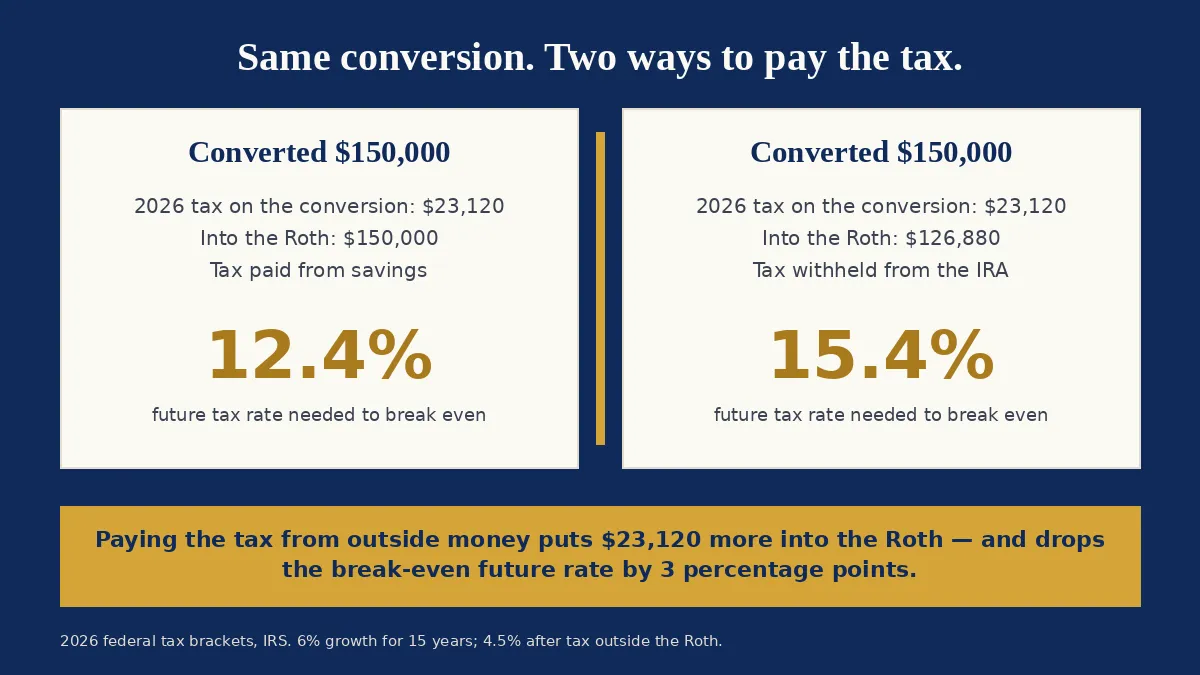
This is the lever that does the most work, and it is the one most often left out.
If Bill and Marie pay the $23,120 from the brokerage account, the full $150,000 lands in the Roth. At 6% for 15 years that becomes $359,484, all of it tax-free. The $23,120 is gone from the taxable account, so it earns nothing further.
If they have the tax withheld from the IRA instead, only $126,880 reaches the Roth. At the same 6% for 15 years that becomes $304,075. The $23,120 stays in the brokerage account and grows at 4.5% to $44,744 — but it is still sitting in a taxable account, being taxed along the way. Household total: $348,819.
Meanwhile, not converting at all leaves $150,000 in the traditional IRA, worth $359,484 before tax at 81, plus that same $44,744 in the brokerage account.
The arithmetic falls out cleanly:
Paying the tax out of the conversion, the break-even future rate is 15.4% — exactly the rate they paid today, as the mechanism section predicted.
Paying the tax from savings, the break-even future rate is 12.4%.
Three percentage points is the whole of the difference, and in this example it is worth $10,665 by age 81 — $359,484 against $348,819. Paying the tax from outside money quietly moves $23,120 of taxable savings into a tax-free account on top of the conversion itself, and that is most of the case for converting.
The reverse is worth stating just as plainly. If the only place the tax money can come from is the IRA, the conversion needs the future rate to be genuinely higher than today's before it does anything at all.
What pushes a future rate up
The break-even is only useful if the future rate in it is honest. Four things commonly raise it, and none of them requires tax law to change.
Required minimum distributions. Withdrawals from a traditional IRA become mandatory at age 73. [3] The amount is the prior year-end balance divided by a factor from the IRS Uniform Lifetime Table, which is 26.5 at age 73. [4] If Bill leaves the whole $600,000 alone and it grows at 6%, it is about $902,000 at 73 and the first RMD is roughly $34,000. Convert $150,000 first and the same growth leaves about $677,000, with a first RMD near $25,500. Roth IRAs carry no required distributions during the owner's lifetime. [3]
A surviving spouse files single. For 2026 the 22% bracket runs to $211,400 of taxable income for a couple filing jointly, but only to $105,700 for a single filer, and the standard deduction drops from $32,200 to $16,100. [1] The same RMD, arriving on a single return, is taxed at a higher rate. That is a future rate most break-even calculations never model.
Medicare surcharges two years out. Part B and Part D premiums are set from a tax return filed two years earlier, and the Social Security Administration's own description of the figure it uses is "your total adjusted gross income and tax-exempt interest income." [5] Bill and Marie's 2026 modified adjusted gross income with the conversion is $188,000. The first joint threshold for 2026 begins above $218,000, so they have about $30,000 of room left before a conversion would trip it — on the 2026 schedule, crossing it costs a couple where both are enrolled $2,296.80 across the year in combined Part B and Part D surcharges. [6] The 2028 thresholds, which is what a 2026 conversion would actually be measured against, have not been published. Our companion piece works this through in detail: how a Roth conversion can raise your Medicare premiums two years later.
Deductions and income tests that phase out. For tax years 2025 through 2028, taxpayers 65 and older may claim an additional $6,000 deduction — $12,000 for a couple where both qualify — which phases out for modified adjusted gross income above $75,000 single and $150,000 joint. [7] At $188,000 of MAGI, Bill and Marie are into that phase-out. Social Security benefits also begin to be taxable once combined income passes $25,000 filing individually or $32,000 filing jointly. [8] A conversion can raise the cost of itself by pulling other income into tax, which is why the blended rate is not always the whole story.
What the break-even cannot tell you
Four honest limits.
It cannot be undone. Conversions made in 2018 or later cannot be recharacterized. [2] Before 2018 a conversion could be reversed after the fact if the numbers went wrong. That escape hatch is closed, which raises the cost of getting the arithmetic wrong.
Five years, and it is measured in tax years. A distribution from a Roth is qualified — tax-free — when it is made after the five-year period beginning with the first tax year a contribution was made to a Roth IRA, and the owner is at least 59½, or the distribution follows death or disability. [4] Someone converting at 66 who expects to spend that money at 69 is inside that window.
Every figure above rests on assumptions. The 6% growth rate, the 4.5% after-tax return on the brokerage account and the 15-year horizon are inputs, not facts. Change the future rate and the whole answer flips. A break-even is a range to look at, not a number to trust.
State tax is missing entirely. Everything here is federal. States differ on how they tax retirement income and on how they treat a conversion, so if you expect to live somewhere else later, that alone can move the break-even.
None of this says a conversion is a good idea or a bad one. It says the answer is specific to a household, and that the specific things it depends on are all things you can look up or estimate for yourself.
Run your own break-even. The Roth Conversion Explorer will take your IRA balance, your other income, a conversion amount and a future tax rate, and show you which side of the line you land on. If Medicare is already in the picture, the Medicare IRMAA calculator on the same page shows how much headroom you have before a conversion crosses a threshold.
Frequently Asked Questions
If my tax rate will be exactly the same later, is a conversion pointless? If you pay the tax out of the conversion itself, yes — the two paths end in exactly the same place, which is what the 15.4% break-even row in the table shows. If you pay it from outside savings, converting still comes out ahead at an identical rate, because that savings money moves into a tax-free account as a side effect.
Why does the growth rate not matter when the tax is withheld from the IRA? Because both paths grow by the same multiple. Converting and withholding leaves you with (100% minus today's rate) of the account growing tax-free; not converting leaves you with 100% of the account growing and then losing (100% minus the future rate). Multiply either one by the same growth factor and the factor cancels. Only the two tax rates survive.
Can I convert a little each year instead of all at once? Converting smaller amounts across several years is how some households keep each year's blended rate down and stay under thresholds. The trade-offs are that the un-converted balance keeps growing, required minimum distributions keep accruing on it after 73 [3], and you are exposed to whatever brackets exist in those later years.
Does converting affect what my children would inherit? It changes the tax treatment. A beneficiary who is not an eligible designated beneficiary is generally subject to the 10-year rule, which requires the entire balance to be withdrawn by December 31 of the year containing the tenth anniversary of the owner's death. [4] Withdrawals from an inherited traditional IRA are ordinary income to the heir; qualified withdrawals from an inherited Roth are not. Whether that is worth paying tax for now depends on the heir's tax rate, which is usually the hardest number in the whole exercise to estimate.
What if I convert and then the market drops? You will have paid tax on a value the account no longer has, and since 2018 there is no way to reverse it. [2] That risk is one reason some people convert in pieces through the year rather than in a single transaction.
Source Links
Every figure in this article comes from one of the government sources below, and the numbered tags in the text show which one. All eight pages were opened and read on 18 September 2026; tax, Medicare and Social Security figures change annually and should be re-checked against the current year.
1. Internal Revenue Service — IRS releases tax inflation adjustments for tax year 2026 The 2026 federal income tax brackets for married-filing-jointly and single filers, and the 2026 standard deduction of $32,200 joint and $16,100 single. Every bracket figure and tax calculation in the worked example traces here.
2. Internal Revenue Service — Publication 590-A, Contributions to Individual Retirement Arrangements (IRAs) That a conversion is included in income in the year it is made, and the rule that there are "no recharacterizations of conversions made in 2018 or later."
3. Internal Revenue Service — Retirement plan and IRA required minimum distributions FAQs The age-73 start for required minimum distributions from a traditional IRA, and that the RMD rules do not apply to Roth IRAs while the owner is alive.
4. Internal Revenue Service — Publication 590-B, Distributions from Individual Retirement Arrangements (IRAs) The Uniform Lifetime Table factor of 26.5 at age 73, the definition of a qualified Roth distribution and its five-year period, and the 10-year rule for beneficiaries who are not eligible designated beneficiaries.
5. Social Security Administration — Medicare premiums The two-year lookback in SSA's own words, and its definition of the modified adjusted gross income used to set Medicare premiums: adjusted gross income plus tax-exempt interest income.
6. Centers for Medicare & Medicaid Services — 2026 Medicare Parts A & B Premiums and Deductibles The 2026 income-related monthly adjustment tables — the $218,000 first joint threshold and the $81.20 and $14.50 per-person monthly surcharges behind the $2,296.80 annual figure for a couple.
7. Internal Revenue Service — Check your eligibility for the new enhanced deduction for seniors The additional $6,000 deduction for taxpayers 65 and older, $12,000 where both spouses qualify, effective 2025 through 2028, and the MAGI phase-out beginning above $75,000 single and $150,000 joint.
8. Social Security Administration — Income taxes and your Social Security benefit The combined-income thresholds at which Social Security benefits begin to be taxable: $25,000 filing individually and $32,000 filing jointly.
Annuity HQ publishes retirement education. This article explains how a calculation works; it is not advice, and it does not recommend a course of action. Individual circumstances differ, state tax treatment varies, and tax, Medicare and Social Security rules change annually. Figures cited apply to the years stated.
 | Jack Whittaker Jack writes the retirement education material at Annuity HQ from Mooresville, North Carolina, drawing on four decades of work with people making income, tax and Medicare decisions at retirement. |
