
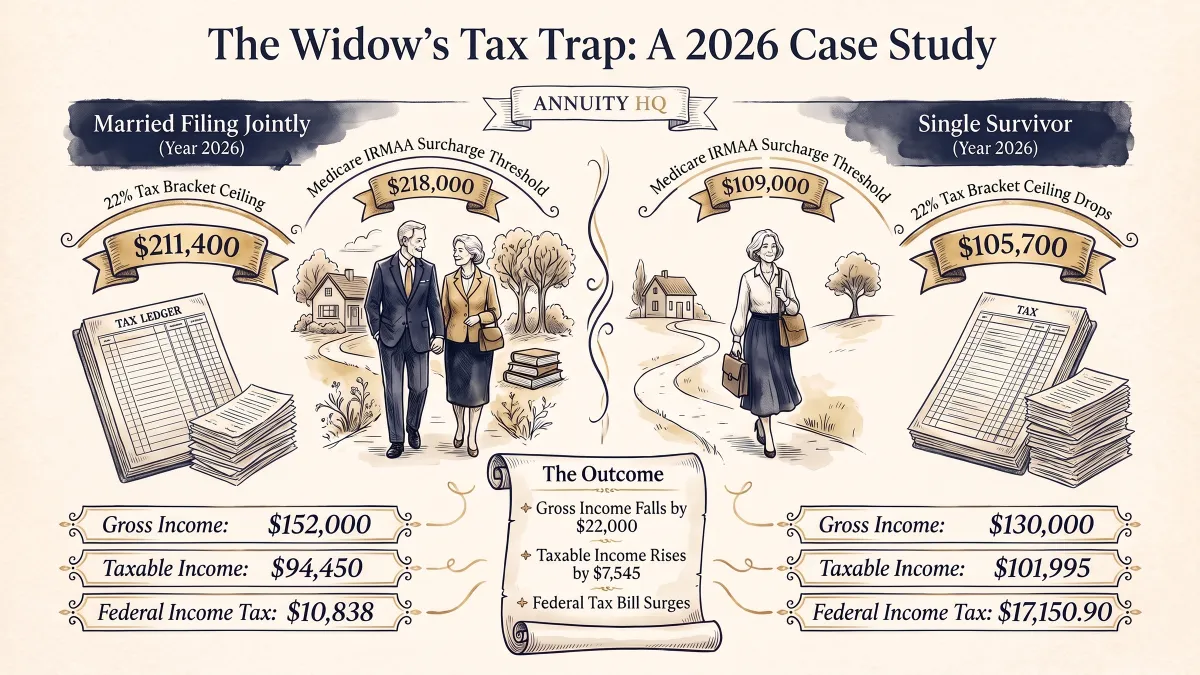
The Widow's Tax Trap: What Happens to Your Taxes and Medicare When One Spouse Dies
Most couples plan retirement as a couple. The income is added up as a couple, the tax bill is figured as a couple, and the Medicare premiums arrive for two people out of one joint account.
Then one of them dies. The household income falls — usually by less than people expect, because the pension and the required withdrawals from the IRA carry on exactly as before. And the tax bill, which ought to fall too, does something else entirely.
This is sometimes called the widow's tax trap, though it applies equally to a surviving husband. Nobody designed it as a penalty. It is what happens when a household's income stays roughly where it was while every threshold it is measured against is cut in half.
Key Takeaways
For tax year 2026 the standard deduction for a single filer is $16,100 against $32,200 for a married couple filing jointly, and the 22% bracket runs out at $105,700 for a single filer against $211,400 for a couple — both exactly half. [1]
The first Medicare IRMAA threshold for 2026 is $109,000 of modified adjusted gross income for a single filer and $218,000 for a couple — again exactly half. [9]
Social Security pays a survivor the higher of the two benefits, not both, so the household's Social Security income falls by the amount of the smaller check. [8]
Pensions with a survivor election and required minimum distributions from a pre-tax account do not fall when one spouse dies, so most of the household's taxable income survives intact.
The survivor keeps filing jointly for the calendar year in which the spouse died; single rates usually apply from the following year, which is when the change first appears on a return. [5]
What actually changes on the tax return
Three separate things change at once, and the timing of each is different.
Filing status. For the calendar year in which a spouse dies, the survivor is still treated as married for the whole year and can file a joint return. [5] After that, qualifying surviving spouse status — which keeps the joint rates and the joint standard deduction for up to two more years — is open only to someone with a dependent child living with them. [5] A couple in their seventies with grown children almost never qualifies, so the status becomes single the next year.
Income. Social Security is the piece that falls. A survivor can receive up to 100% of the deceased worker's benefit at full retirement age for survivor benefits, but where they are already drawing a retirement benefit of their own, the Social Security Administration is explicit that the two payments "won't be added together" — the survivor keeps whichever is larger. [8] The smaller check simply stops.
Everything else usually does not fall. A pension elected with a full joint-and-survivor benefit keeps paying at the same rate. Required minimum distributions continue — a spouse who is the sole beneficiary can move the inherited IRA into their own name, and withdrawals resume against the same balance. RMDs begin at age 73 and are the prior 31 December balance divided by a factor from the IRS Uniform Lifetime Table. [6] Nothing in that calculation halves because the household is now one person.
Every number that matters is cut in half
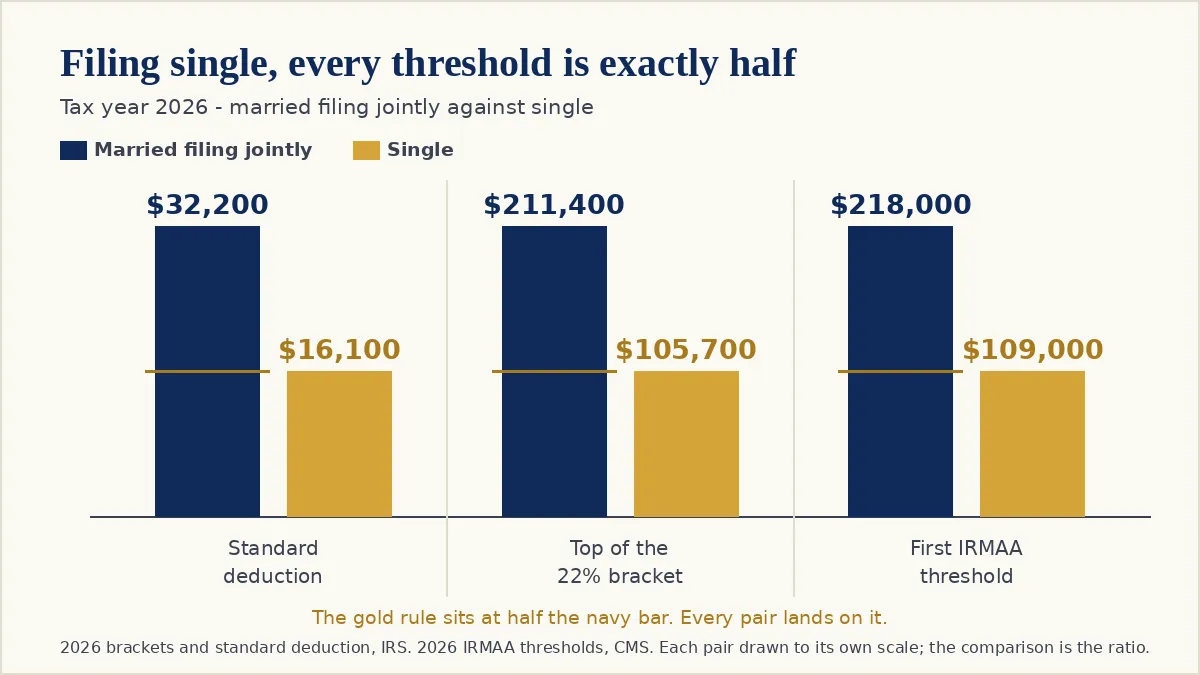
The federal tax system does not scale a single filer's thresholds to their actual expenses. It scales them to exactly half of a married couple's, and it does that across the board.
For tax year 2026 the basic standard deduction is $32,200 for a married couple filing jointly and $16,100 for a single filer. [1] The 22% bracket runs to $211,400 of taxable income on a joint return and to $105,700 on a single return. [1] The first Medicare IRMAA threshold for 2026 sits at $218,000 of modified adjusted gross income for a couple and $109,000 for a single filer. [9]
Two smaller deductions move in the same direction but not by half, and both matter at this age. The additional standard deduction for being 65 or older is $1,650 for each spouse on a married return and $2,050 for an unmarried filer for 2026 — so a couple claims $3,300 between them and the survivor claims $2,050. [2]
The newer deduction for seniors is the one that moves most sharply. For tax years 2025 through 2028 a taxpayer aged 65 or older may deduct up to $6,000, or $12,000 where both spouses on a joint return qualify, and it phases out above modified adjusted gross income of $75,000 for a single filer and $150,000 for joint filers. [3] The phase-out is worked on Schedule 1-A: the amount by which MAGI exceeds the threshold is multiplied by 6%, and the result is subtracted from the $6,000. [4] So a survivor loses one $6,000 deduction outright, and the phase-out on what remains starts at half the income it used to.
Stack those together and the deduction side of the return can fall further, in dollars, than the income side does.
A worked example: the same income, two filing statuses
Here is a couple, both 74 in 2026. The figures are invented but the rules applied to them are not.
Combined traditional IRA and 401(k) balances on 31 December 2025: $1,147,500. At age 74 the Uniform Lifetime Table factor is 25.5, which makes the 2026 required minimum distribution $45,000. [6]
A pension of $40,000 a year, elected with a 100% joint-and-survivor benefit, so it continues unchanged to the survivor.
Social Security of $45,000 a year for the higher earner and $22,000 for the lower.
Household gross income: $152,000. When the higher earner dies, the $22,000 check stops and the other three do not. Gross income falls to $130,000 — a drop of 14.5%.
Both columns below are run through tax year 2026 with the same pension and the same RMD, so that nothing moves except filing status. In life the two returns are a year apart and other things move too; this is the filing-status effect on its own.
Tax year 2026 | Married filing jointly | Single survivor |
|---|---|---|
Social Security received | $67,000 | $45,000 |
Pension | $40,000 | $40,000 |
Required minimum distribution | $45,000 | $45,000 |
Gross income | $152,000 | $130,000 |
Taxable portion of Social Security | $56,950 | $38,250 |
Adjusted gross income | $141,950 | $123,250 |
Standard deduction + age 65 add-on | $35,500 | $18,150 |
Deduction for seniors | $12,000 | $3,105 |
Total deductions | $47,500 | $21,255 |
Taxable income | $94,450 | $101,995 |
Top bracket reached | 12% | 22% |
Federal income tax | $10,838 | $17,150.90 |
Annual Medicare IRMAA surcharge | $0 | $1,148.40 |
Federal tax + surcharge | $10,838 | $18,299.30 |
Gross income fell by $22,000. Taxable income went up by $7,545. Federal income tax rose by $6,312.90, or 58%, and once the Medicare surcharge is added the combined bill rose by $7,461.30 — just under 69%.
Run your own figures. The Medicare IRMAA calculator and the RMD calculator at Annuity HQ take your own balances and income and show where you sit against the 2026 thresholds — under both filing statuses. It takes a couple of minutes and the arithmetic above is the arithmetic they use.
Why a smaller income produced a bigger tax bill
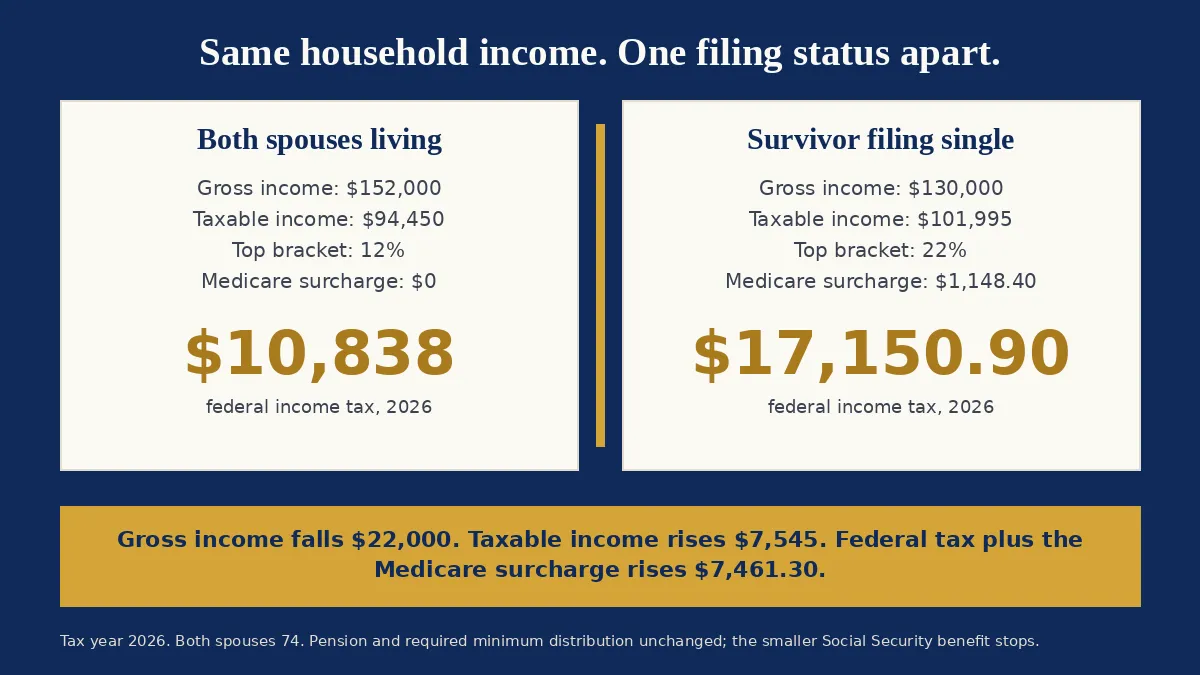
The result above looks like an error until the two sides are separated.
Adjusted gross income fell by $18,700. Total deductions fell by $26,245. The deduction side dropped $7,545 further than the income side, and taxable income is what is left when one is subtracted from the other — so taxable income rose by exactly that $7,545.
Social Security offers no relief either. The taxable share of a benefit is set by "combined income" — other income plus half the benefit — against thresholds of $25,000 and $34,000 single and $32,000 and $44,000 joint. [7] Those are the dollar figures from the 1983 and 1993 legislation, carried forward with no annual inflation adjustment. [7]
The couple's combined income of $118,500 was far above $44,000, so the maximum 85% of their $67,000 benefit — $56,950 — was taxable. The survivor's $107,500 is just as far above $34,000, so the maximum 85% of her $45,000 benefit — $38,250 — is taxable. [7] Her benefit fell by a third; the taxable proportion did not move at all. There is no band for her to drop back into, because the threshold she would have to fall below is itself lower than the couple's.
And the marginal rate doubles. The couple's last dollar of taxable income was taxed at 12%, because the 12% band on a joint return runs to $100,800 and their taxable income was $94,450. The survivor's last dollar is taxed at 22%, because the 12% band for a single filer runs out at $50,400 and her taxable income is $101,995. [1] Every additional dollar she takes out of the IRA now costs nearly twice what the same dollar cost the household a year earlier.
The Medicare part arrives two years late
Medicare premiums are the piece most people never connect to the death at all, because they show up long after it.
The standard Part B premium for 2026 is $202.90 a month, with a $283 annual deductible. [9] Above the income thresholds an income-related monthly adjustment is added to both Part B and Part D. In the first band above the line for a single filer — modified adjusted gross income over $109,000 and up to $137,000 — the Part B adjustment is $81.20 a month, taking the premium to $284.10, and the Part D adjustment is $14.50. [9]
The survivor in the example has modified adjusted gross income of $123,250, which lands in that band. Her own Part B premium rises 40%, and between Part B and Part D she pays $1,148.40 a year she was not paying before. [9]
Worth being precise about one thing: the household now pays one Part B premium instead of two, so its total Medicare outlay in dollars falls. What rises is what she pays for herself — and it rises because a threshold moved, not because her income did.
The delay comes from the lookback. Social Security sets 2026 premiums from the 2024 return, generally filed in 2025 — the same two-year lag that catches people out after a Roth conversion. [11] The lookback also fixes which table applies: the sliding scale is chosen by the filing status on that older return, not the status held now. [10] So a survivor keeps being measured against the joint thresholds while the return in the window is still a joint one, and the single thresholds — at half the level — take effect roughly two years after the death.
There is a form for part of this. Death of a spouse is one of the life-changing events for which Social Security will make a new initial determination, requested on form SSA-44. [12] What that form does is let a beneficiary substitute a more recent year's income for the lookback year's. What it does not do is change which threshold table applies. Where the problem is a real fall in income, SSA-44 addresses it; where the problem is that the threshold halved, it does not.
What this example cannot tell you
The arithmetic above is general. The size of the effect is not.
State income tax is left out entirely, and it varies enormously — some states tax no retirement income, some tax Social Security, and several offer age-based exemptions that themselves change with filing status. That alone can move the total in either direction.
The mix matters more than the total. A household whose income is mostly Social Security sees a much smaller effect than one carrying a pension and a large required distribution, because the thresholds bite hardest where there is a lot of ordinary income to run against them. A household already above the top IRMAA band sees no IRMAA change at all, because there is nothing left to cross.
Pension elections change the picture too. The example assumes a 100% joint-and-survivor benefit. A 50% election would have cut the pension as well — lowering the tax bill, and the household's income with it. A single-life pension would have stopped altogether.
And the piece nobody can settle in advance: how long the survivor lives with it. A gap of $7,461 in one year is a different thing from the same gap for twenty.
What is knowable is the structure. Filing status changes in a specific year, the thresholds are published in advance, and the two-year Medicare lookback means the second half of the effect can be seen coming well before it lands. Anyone can put their own figures into it and find their own number — which is a different exercise from being told what to do about it, and the only one a general article can honestly offer.
See where your household sits. The RMD and Medicare IRMAA calculators will show you your required distribution for the year and the modified adjusted gross income it produces, against the 2026 thresholds for both filing statuses. Running it twice — once joint, once single — is how the gap in this article becomes a number with your name on it.
Frequently Asked Questions
If my spouse dies in March, do I have to file as single for that year? No. For the calendar year in which a spouse dies the survivor is treated as married for the whole year and may file a joint return, provided they have not remarried before the year ends. [5] The change in filing status generally first affects the return for the following year.
Doesn't qualifying surviving spouse status protect me for two more years? Only if a dependent child lives with you. Qualifying surviving spouse status keeps the joint rates and the joint standard deduction for up to two years after the year of death, but it requires a qualifying dependent. [5] Most households in their seventies do not meet that test, so the filing status becomes single in the next tax year.
Why did my required minimum distribution not go down? Because the account did not. A surviving spouse who is the sole beneficiary can treat the inherited IRA as their own, and the required minimum distribution is then the prior 31 December balance divided by the Uniform Lifetime Table factor for their age. [6] The calculation has no term in it for how many people are in the household.
Can I appeal the higher Medicare premium? Death of a spouse is one of the life-changing events for which Social Security will consider a new initial determination, requested on form SSA-44 with supporting evidence. [12] That process substitutes a more recent year's income for the income in the lookback year. It does not change the income thresholds themselves, so it helps where income actually dropped below a band and not where the band simply moved.
Why do the 2026 premiums use income from 2024? Social Security sets the income-related adjustment from the most recent federal return the IRS has provided, which for 2026 premiums is generally the 2024 return filed in 2025. [11] That two-year lag is also why the filing status used is the one on that older return rather than the current one. [10]
Source Links
All figures current for tax year 2026 and Medicare year 2026, checked 21 September 2026. Tax brackets, standard deductions, Medicare premiums and IRMAA thresholds are adjusted annually — confirm the current year's figures before applying any of this to your own return.
1. Internal Revenue Service — Tax inflation adjustments for tax year 2026 The 2026 standard deduction of $32,200 joint and $16,100 single, and the 2026 brackets for both statuses: 12% to $100,800 and $50,400, 22% to $211,400 and $105,700.
2. Internal Revenue Service — Revenue Procedure 2025-32 The 2026 additional standard deduction for age 65 or older: $1,650 married, $2,050 unmarried and not a surviving spouse.
3. Internal Revenue Service — The enhanced deduction for seniors The $6,000 per-person senior deduction ($12,000 where both spouses qualify), tax years 2025–2028, phasing out above $75,000 single and $150,000 joint.
4. Internal Revenue Service — Schedule 1-A (Form 1040), Additional Deductions The phase-out arithmetic in Part V: MAGI above the threshold multiplied by 6%, subtracted from $6,000.
5. Internal Revenue Service — Publication 501 That a survivor may file jointly for the year of death, and that qualifying surviving spouse status afterwards requires a qualifying dependent.
6. Internal Revenue Service — Publication 590-B The required beginning age of 73, the prior-31-December-balance calculation, and the Uniform Lifetime Table factor of 25.5 at age 74.
7. Social Security Administration, Office of the Chief Actuary — Taxation of Social Security Benefits The combined-income thresholds of $25,000 and $34,000 single and $32,000 and $44,000 joint, and the 50% and 85% tiers from the 1983 and 1993 legislation.
8. Social Security Administration — What you could get from Survivor benefits Up to 100% of the deceased worker's benefit at full retirement age for survivor benefits, and that a survivor's own benefit and a survivor benefit "won't be added together".
9. Centers for Medicare & Medicaid Services — 2026 Medicare Parts A & B Premiums and Deductibles The $202.90 standard Part B premium, the $283 deductible, and the 2026 Part B and Part D IRMAA tables — the $109,000 and $218,000 first thresholds and the $81.20 and $14.50 first-band adjustments.
10. Social Security Administration — POMS HI 01101.020, IRMAA Sliding Scale Tables That the table applied is chosen by the tax filing status and MAGI on the lookback year's return.
11. Social Security Administration — Medicare Premiums That 2026 adjustments are set from the 2024 return, generally filed in 2025, with 2023 used if 2024 is unavailable.
12. Social Security Administration — Request to lower an IRMAA That death of a spouse is a qualifying life-changing event, requested on form SSA-44 with supporting evidence.
This article is educational and is not tax, legal, investment or insurance advice. Tax and Medicare rules change, apply differently in every state, and depend on individual circumstances; figures here are illustrative and current for 2026 as of the date above.
 | Jack Whittaker Jack writes the retirement education material at Annuity HQ from Mooresville, North Carolina, drawing on four decades of work with people making income, tax and Medicare decisions at retirement. |
