
What Your Heirs Actually Inherit: Roth and Traditional Accounts Under the 10-Year Rule
Most people picture an inheritance as a number. The statement says $600,000, so that is what the children get.
For a traditional IRA or 401(k), that is not what the children get. It is what they get before the tax, and the tax is charged at their rate, not at yours — in their working years, on top of a salary, in a ten-year window they mostly do not control.
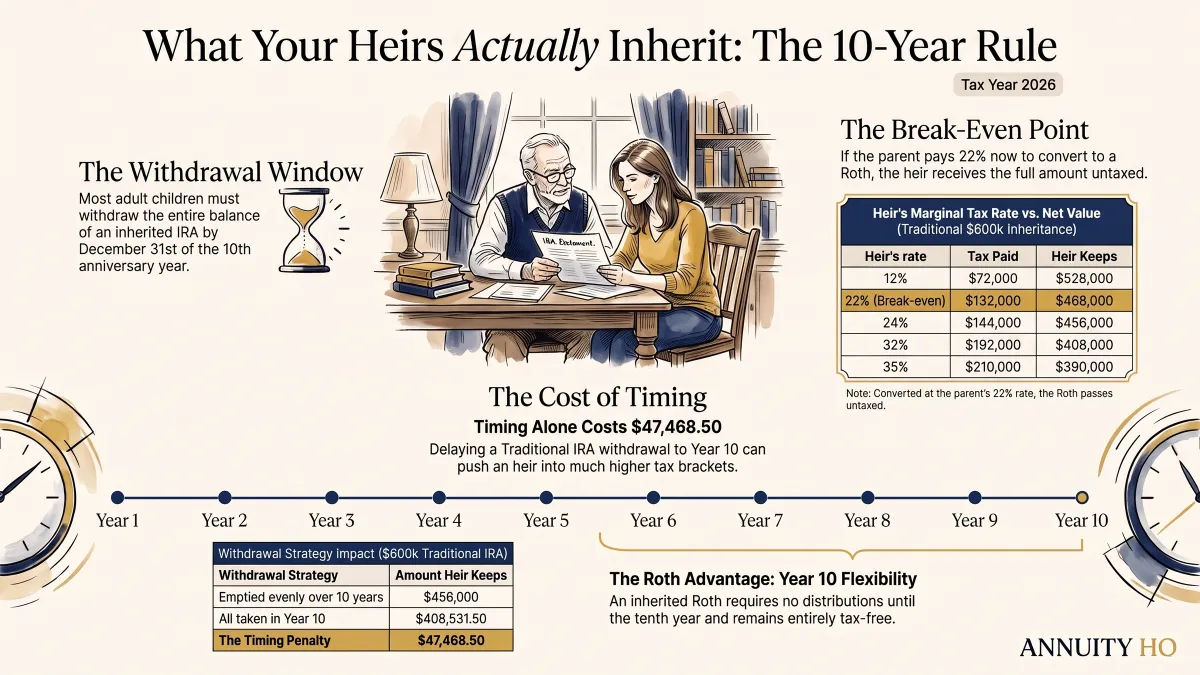
That last part is new. For deaths after 2019 most adult children can no longer stretch an inherited retirement account across their own lifetime. The account has to be emptied, and the compressed timetable is what turns a difference in tax rates into a difference in dollars.
Key Takeaways
A beneficiary subject to the 10-year rule must "withdraw the entire balance of the IRA by December 31 of the year containing the 10th anniversary of the owner's death." [1]
Money coming out of an inherited traditional account is ordinary income to the heir, so the bill is set by the heir's marginal rate. On a $600,000 account that is $72,000 of tax at 12% and $210,000 at 35% — a $138,000 spread on an identical account. [6]
Where the tax on a conversion is paid out of the account itself, growth and the length of the heir's ten years cancel out entirely, and the comparison reduces to two numbers: the rate the owner paid and the rate the heir would pay.
Roth owners are not required to take distributions during their lifetime, so a Roth is never drained by the owner's required withdrawals the way a traditional account is. [3]
A Roth IRA owner is always treated as having died before the required beginning date, which means a beneficiary under the 10-year rule owes nothing in years one through nine and can leave the account alone until the final year. [4] [1]
What the 10-year rule actually requires
The rule applies to a designated beneficiary who is not an eligible designated beneficiary — which, for most families, means an adult child.
The IRS defines an eligible designated beneficiary as "the owner's surviving spouse, the owner's minor child, a disabled individual, a chronically ill individual, or any other individual who is not more than 10 years younger than the IRA owner." [1] A 52-year-old son inheriting from a 75-year-old parent fits none of those, so the 10-year rule applies to him.
What it requires is a deadline, not a schedule. The account must be emptied "by the end of the 10th year following the year of the account owner's death." [2] Publication 590-B puts the same deadline as 31 December of the year containing the tenth anniversary of the death. [1]
Whether anything has to come out before that final year is a separate question, and the answer turns on one date: whether the owner had reached their required beginning date. Required minimum distributions from a traditional account begin at age 73. [3]
Owner died before the required beginning date. Publication 590-B is direct: "If the IRA owner dies before the required beginning date and the 10-year rule applies, no distribution is required for any year before the 10th year." [1]
Owner died on or after it. The final regulations issued in July 2024 read the two statutory provisions together and "generally require annual distributions to continue while also requiring full distribution of the employee's interest in the plan by the end of the calendar year that includes the tenth anniversary of the date of the employee's death." [5] Those regulations apply to distributions for calendar years beginning on or after 1 January 2025. [5]
Missing a required distribution carries an additional tax of 25% of the shortfall, reduced to 10% if it is taken and reported during the correction window. [7]
Here is where the Roth side diverges, and it is the part that is rarely stated plainly. No minimum distributions are required from a Roth IRA while the owner is alive [3], so the owner never has a required beginning date to reach. The regulation closes the loop: "The minimum distribution rules apply to the Roth IRA as though the Roth IRA owner died before his or her required beginning date." [4]
A Roth IRA owner therefore dies before the required beginning date no matter how old they are. Their beneficiary lands in the first bullet above, always: nothing required until the tenth year.
Whose rate pays the bill
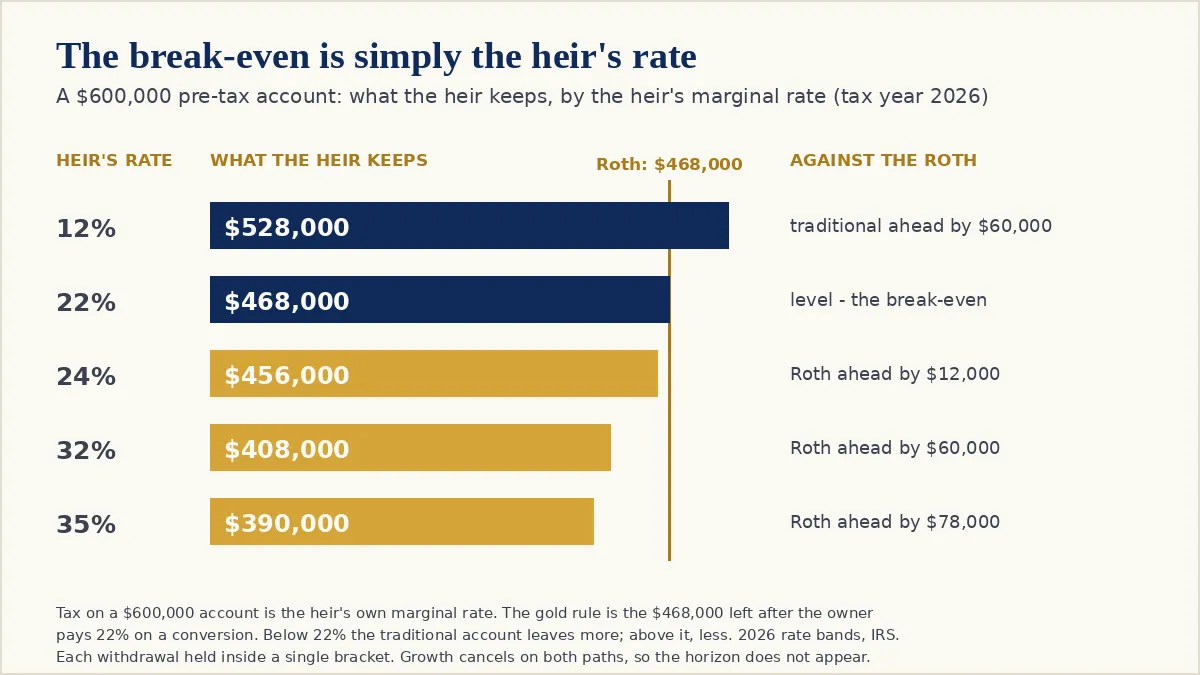
Strip the two accounts back and one difference remains. A traditional account has never been taxed; a Roth has already been taxed. The question is only ever at whose rate.
That framing kills the most common explanation of why a Roth wins, which is that it grows tax-free. A traditional IRA also compounds untaxed — the tax is simply charged once, at the end. If the rate is the same at both ends and the conversion tax is paid out of the account, the two finish in exactly the same place.
The arithmetic is worth seeing because it is so blunt. Call the balance B, the owner's rate t, and let the money grow by a factor g over the heir's ten years. Convert, paying the tax from the account, and the heir receives B(1 − t) × g, tax-free. Leave it, and the heir receives B × g, taxed at their own rate h, which is B × g × (1 − h). The g sits in both expressions and cancels. So does the number of years.
What is left is t against h. The break-even is not a percentage anyone has to look up — it is simply the point where the heir's rate equals the rate the owner paid.
That is the whole mechanism, and it is why the heir case is different from the owner's own case. A retired parent and a working child are rarely in the same bracket. In tax year 2026 a single filer is in the 22% band from $50,400 to $105,700 of taxable income, while a married couple filing jointly is in the 24% band from $211,400 to $403,550 and the 32% band from there to $512,450. [6]
Per dollar, the gap is easy to feel. A dollar moved at a 12% rate reaches the heir as 88 cents. The same dollar left in the account and withdrawn by an heir at 24% reaches them as 76 cents. That is 15.8% more on the first route — on the same dollar, from the same account.
Same $600,000, and it matters who is holding it
Take a specific case. The figures are invented; the rules applied to them are not.
Margaret is 75 in 2026 and files as a single taxpayer. Her traditional IRA held $600,000 on 31 December 2025, and her taxable income puts her marginal rate at 22%. Her son David is 52, files jointly with his wife, and their taxable income is $250,000 before anything is inherited — the 24% band for 2026. [6]
If Margaret converts and pays the tax out of the account, $132,000 goes to the IRS and $468,000 becomes Roth money that reaches David untaxed. If she does not, David inherits $600,000 of pre-tax money and settles the bill himself.
The table below runs the same $600,000 against a range of heir rates, holding each withdrawal inside a single band so the rate comparison is not tangled up with bracket-crossing. The next section deals with what happens when it is not.
David's marginal rate | Tax on the $600,000 | David keeps | Against the Roth's $468,000 |
|---|---|---|---|
12% | $72,000 | $528,000 | traditional ahead by $60,000 |
22% | $132,000 | $468,000 | level — the break-even |
24% | $144,000 | $456,000 | Roth ahead by $12,000 |
32% | $192,000 | $408,000 | Roth ahead by $60,000 |
35% | $210,000 | $390,000 | Roth ahead by $78,000 |
Two things are worth sitting with.
The first is that the line is symmetrical. Below Margaret's 22%, the traditional account wins, and wins by real money — an heir in the 12% band keeps $60,000 more by inheriting the untaxed account. Converting is not free and it is not automatically right; it is a trade of a known rate now for an unknown rate later, and the direction of the trade depends entirely on which way the rates fall.
The second is that nobody knows h. David's bracket in the year he inherits is not knowable today, and neither are the brackets themselves, which Congress can change. What is knowable is that a working adult in their fifties is more often above a retired parent's rate than below it — and that is a tendency, not a forecast.
Put your own two rates side by side. The Roth Conversion Explorer at Annuity HQ takes your balance and your own income and shows the rate a conversion would actually be taxed at this year — which is the left-hand side of every row in that table. The right-hand side is a conversation with whoever will inherit it.
The ten-year clock is itself a tax decision
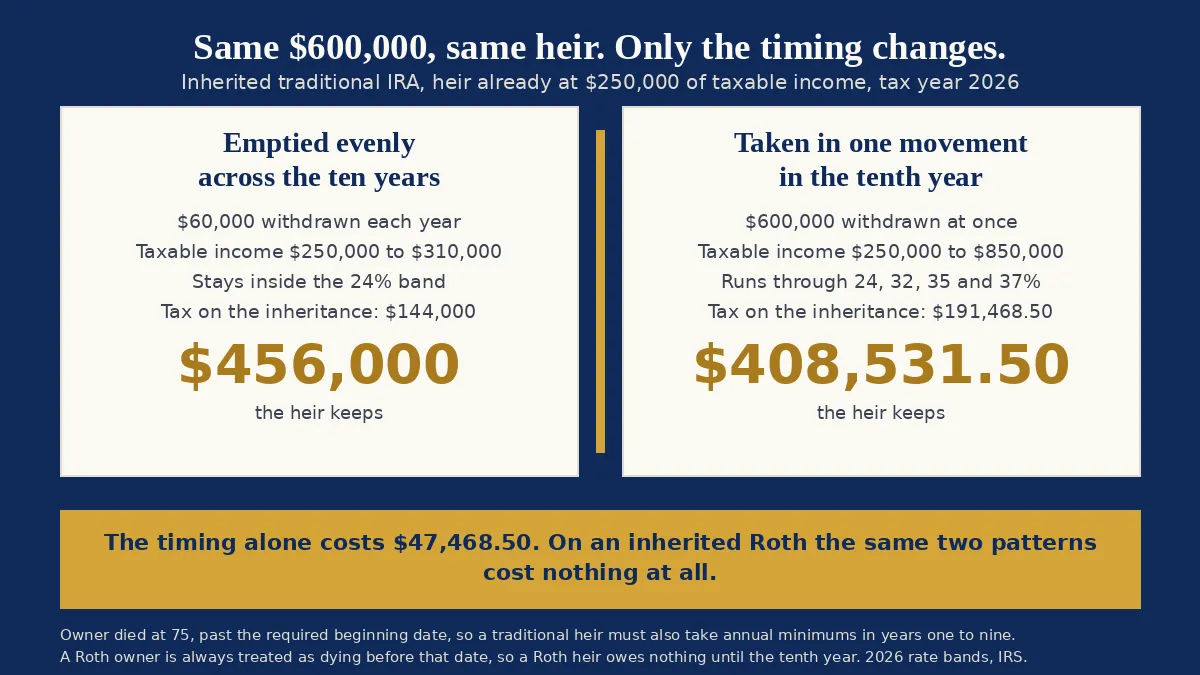
The table above quietly assumed David keeps each withdrawal inside one bracket. The ten-year deadline is what makes that assumption fragile, because the account has to come out whether or not a good year exists to take it in.
Suppose David does it the tidy way: an even tenth, $60,000, each year for ten years. His taxable income goes from $250,000 to $310,000, which stays inside the 24% band. [6] The extra tax is $14,400 a year, or $144,000 over the ten. He keeps $456,000.
Now suppose he leaves it alone and takes the whole $600,000 in the final year. That single year's taxable income is $850,000. The money stacks upward through the 24%, 32%, 35% and 37% bands, and the tax on the inherited portion is $191,468.50. [6] He keeps $408,531.50.
Same account, same heir, same ten years. The timing alone costs $47,468.50.
This is where the two account types stop looking similar. Because Margaret was 75, she had passed the required beginning date, so a traditional inheritance would oblige David to take annual distributions through years one to nine as well as emptying the account by the end of year ten. [5] Those annual minimums are calculated from his own life expectancy rather than as a flat tenth, and they are usually smaller than a tenth — which means a traditional heir gets a floor, not a plan. Left at the minimum, the balance still arrives in the final year.
A Roth heir has the opposite position, and a better one. Nothing is required in years one through nine [1][4], and because none of it is taxable income, the $47,468.50 decision does not exist. The account can sit untouched for ten years and come out in one movement at no cost. The timing question is not answered well — it is deleted.
Two things the table leaves out
The owner's own withdrawals. A traditional account is drained during the owner's life; a Roth is not. Required distributions begin at 73 and are the prior 31 December balance divided by a factor from the Uniform Lifetime Table. [1] At 75 the factor is 24.6, so the table requires 4.07% of the balance that year — on Margaret's $600,000, a withdrawal of $24,390.24. [1] The required share rises with age: the factor is 20.2 at 80 and 16.0 at 85, which is 4.95% and 6.25%. [1]
A Roth has no equivalent, because the distribution rules simply do not apply while the owner is alive. [3] Whatever the owner does not spend stays in the account. How much difference that makes depends on how long the owner lives and what the money earns, which is why it is not in the table — but the direction is not in doubt.
The five-year requirement. An inherited Roth is not automatically tax-free in every part. Withdrawals of contributions are tax free, and most withdrawals of earnings are too, but "withdrawals of earnings may be subject to income tax if the Roth account is less than 5-years old at the time of the withdrawal." [2] An account converted shortly before death and inherited immediately can fail that test on its earnings. The ten-year window is long enough for the clock to run out on its own, which is one reason a Roth heir is rarely in a hurry.
What this example cannot tell you
State income tax is left out entirely, and it does not follow the federal treatment. Some states tax retirement income and some do not; the heir's state, not the owner's, is generally the one that matters, and an heir who has moved can face a completely different result from a sibling who has not.
The example also assumes one adult child. Split an account between three beneficiaries and each of them runs their own ten-year clock against their own bracket — the same account can be a 12% inheritance for one of them and a 35% inheritance for another, at the same moment.
Beneficiary form beats will. A retirement account passes by the beneficiary designation on file with the custodian, and a form left blank or left in the name of someone who has since died can pull an account out of the designated-beneficiary rules altogether and into a shorter, harsher timetable. It costs nothing to read the form; it is also the single most commonly out-of-date document in a retirement file.
And the largest unknown stays unknown. Nobody can say what an heir's marginal rate will be in ten or twenty years, nor what the brackets will look like. What the arithmetic above does is make the size of the bet visible: converting exchanges a rate you can look up today for a rate nobody can look up yet. That trade suits a household whose own rate is unusually low and whose heirs are plainly earning more, and it works against a household in the reverse position. Which of those two describes a particular family is a question of arithmetic, and the numbers for it are all published.
Run the ten years before they run. The Required Minimum Distribution and Roth Conversion calculators at Annuity HQ show what your account is obliged to pay out each year and what a conversion would cost at your own current rate. Run it once for yourself and once at the bracket you think your children are in — the gap between those two answers is what this article is about.
Frequently Asked Questions
Does my child have to take something out every year, or can they wait until year ten? It depends on which account and on your age at death. For a traditional account where the owner died before the required beginning date, "no distribution is required for any year before the 10th year." [1] Where the owner died on or after it, annual distributions continue alongside the ten-year deadline. [5] For a Roth IRA the rules apply "as though the Roth IRA owner died before his or her required beginning date" whatever the owner's age, so nothing is required until the final year. [4]
Is an inherited Roth completely tax free? Withdrawals of contributions are tax free and most withdrawals of earnings are as well, but earnings may be taxable if the account is less than five years old when they are withdrawn. [2] Inherited Roth accounts are still subject to the distribution rules — the deadline applies even though the tax generally does not. [2]
My spouse is my beneficiary. Does the ten-year rule apply to them? A surviving spouse is an eligible designated beneficiary, along with a minor child of the owner, a disabled or chronically ill individual, and anyone not more than ten years younger than the owner. [1] Eligible designated beneficiaries are outside the ten-year rule and have their own options. The rule generally reaches the next generation rather than the spouse. What changes for the surviving spouse's own tax return is a separate problem, covered in our article on the widow's tax trap.
What happens if my child simply forgets a required withdrawal? The additional tax is 25% of the amount that should have been distributed, reduced to 10% where the shortfall is distributed and reported during the correction window. [7] The correction window runs, broadly, to the last day of the second taxable year beginning after the year in which the tax was imposed, and it closes earlier if a deficiency notice is mailed or the tax is assessed. [7]
Is converting always better for the people who inherit? No. The break-even is the point where the heir's marginal rate equals the rate paid on the conversion. Below it the traditional account leaves the heir more — in the example above, an heir in the 12% band keeps $60,000 more than the Roth would have delivered. [6] The conversion also brings forward a tax bill that would otherwise be years away, and a conversion large enough to matter rarely stays in one bracket, which is a cost this article's table sets aside. The relevant comparison is your own rate today against a rate that has to be estimated.
How does this connect to Medicare? A conversion raises modified adjusted gross income in the year it is done, and Medicare sets its income-related premium adjustments from a return two years old — so the premium consequence arrives well after the conversion does. That mechanism is worked through in detail in our article on Roth conversions and Medicare premiums.
Source Links
All figures current for tax year 2026, checked 25 September 2026. Tax brackets, standard deductions and the life expectancy tables are adjusted periodically — confirm the current year's figures before applying any of this to your own return.
1. Internal Revenue Service — Publication 590-B, Distributions from Individual Retirement Arrangements The 10-year rule deadline of 31 December of the year containing the tenth anniversary of death; that no distribution is required before the 10th year where the owner died before the required beginning date; the definition of an eligible designated beneficiary; and the Uniform Lifetime Table factors of 24.6 at age 75, 20.2 at 80 and 16.0 at 85.
2. Internal Revenue Service — Retirement topics: Beneficiary That the account must be emptied by the end of the 10th year following the year of death; that inherited Roth accounts are subject to the same distribution requirements as inherited traditional accounts; and that withdrawals of earnings from an inherited Roth may be taxable if the account is less than five years old.
3. Internal Revenue Service — Retirement plan and IRA required minimum distributions FAQs That the required minimum distribution rules do not apply to Roth IRAs or designated Roth accounts while the owner is alive, and that withdrawals from traditional accounts generally must begin at age 73.
4. Electronic Code of Federal Regulations — 26 CFR § 1.408A-6, Distributions Q&A-14: that no minimum distributions are required from a Roth IRA while the owner is alive, and that after death "the minimum distribution rules apply to the Roth IRA as though the Roth IRA owner died before his or her required beginning date."
5. Federal Register — Required Minimum Distributions, final regulations, 19 July 2024 (TD 10001) That where the owner died on or after the required beginning date the regulations "generally require annual distributions to continue while also requiring full distribution … by the end of the calendar year that includes the tenth anniversary," and that the regulations apply for calendar years beginning on or after 1 January 2025.
6. Internal Revenue Service — Tax inflation adjustments for tax year 2026 The 2026 marginal rate bands used throughout: for joint filers 22% to $211,400, 24% to $403,550, 32% to $512,450, 35% to $768,700 and 37% above it; and for single filers 12% to $50,400 and 22% to $105,700.
7. Internal Revenue Service — Instructions for Form 5329 The 25% additional tax on an amount that should have been distributed, the reduced 10% rate for a distribution made and reported during the correction window, and the definition of that window.
This article is educational and is not tax, legal, investment or insurance advice. Tax rules change, apply differently in every state, and depend on individual circumstances; figures here are illustrative and current for 2026 as of the date above.
 | Jack Whittaker Jack writes the retirement education material at Annuity HQ from Mooresville, North Carolina, drawing on four decades of work with people making income, tax and Medicare decisions at retirement. |
