
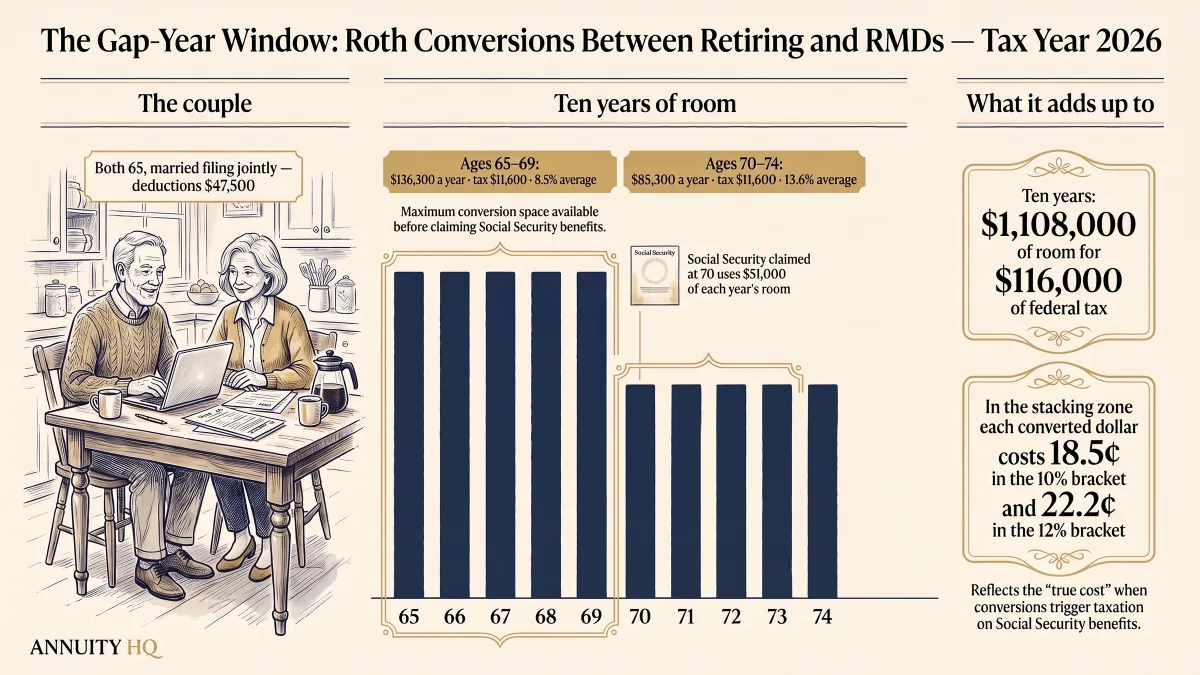
Roth Conversions in the Gap Years: The Window Between Retiring and RMDs
The paycheck stops. Social Security has not started yet, and the required withdrawals from your traditional IRA are years away. For a stretch of time, your taxable income may be lower than it has been since your twenties.
Planners call it the gap years: the one period when a large pre-tax balance can be moved into a Roth at the bottom of the brackets. It closes on a timetable you can read off published rules.
This article works the window itself: how many years it runs, how much room each year holds at the 2026 brackets, and what shuts it.
Key Takeaways
Converting a traditional IRA to a Roth IRA adds the converted amount to your taxable income for the year of the conversion, and a conversion made after 2017 cannot be undone. [8]
Required minimum distributions start at 73 for people born from 1951 through 1958 and at 75 for people born in 1960 or later, so anyone born in 1960 or later has until 75, not 73. [6]
For a married couple, both 65, with $12,000 of other income, 2026 deductions of $47,500 leave room to convert $136,300 a year before crossing out of the 12% bracket, at a federal tax cost of $11,600. [1] [2] [3]
Once Social Security starts, up to 85% of it becomes taxable, and in the example that takes $51,000 out of each year's room — the same $11,600 of tax now buys an $85,300 conversion instead of $136,300. [5]
Converting at a low rate only pays if the same dollars would otherwise be taxed at a higher one. Where the later rate turns out lower, leaving the money in the traditional account comes out ahead.
What the gap years are, and why they are low-tax years
A traditional IRA or 401(k) has never been taxed, so every dollar that comes out — spent or moved to a Roth — is ordinary income. The amount you convert must be included in your gross income, normally on the return for the year of the conversion. [8]
What makes the gap years different is what else is on the return. Wages have stopped. Social Security can start as early as 62 [10], but a person who waits to 70 earns delayed retirement credits of 8% a year, and those credits stop at 70. [9] Required distributions have not begun. A household living on cash savings can have very little taxable income at all.
Meanwhile the deductions are unusually large. For 2026 a married couple filing jointly has a standard deduction of $32,200. [1] Each spouse who is 65 or older adds $1,650. [2] And from 2025 through 2028, each person 65 or older may claim a further $6,000 deduction for seniors — $12,000 for a couple where both qualify. [3]
Add those up and a 65-year-old couple can have $47,500 of income in 2026 before any of it is taxed. Above that, the first $24,800 of taxable income is taxed at 10% and the next $76,000, up to $100,800, at 12%. [1] That empty space is the "room" a conversion can fill.
How long the window runs
The Social Security start date. Whenever benefits begin, part of them becomes taxable once other income is high enough — and a conversion is other income. For a joint return, the calculation starts from a $32,000 base amount, and up to 85% of benefits can be taxable. [5] Claiming does not shut the window, but it narrows it every year from then on.
The required beginning date. The final regulations set the applicable age by year of birth: 73 for people born from 1 January 1951 through 31 December 1958, and 75 for people born on or after 1 January 1960. [6] The regulation marks the entry for people born in 1959 as reserved, so anyone born that year should confirm their own age with their plan or custodian.
The first distribution can be delayed until April 1 of the year after you reach that age. [7] But from the year you reach it, the required amount has to come out before anything can be converted — amounts that must be distributed for a year, including the year you reach the age, cannot be converted. [8] The distribution is income, and it uses up room.
So the window's length is arithmetic on your own dates. Someone retiring at 65 who was born in 1961 has ten calendar years, 65 through 74, before required distributions start at 75. Someone born in 1957 who retires at 66 has seven, 66 through 72.
How much room there is each year
The people below are invented; the rules applied to them are not.
Tom and Linda are both 65 in 2026 and file jointly. Both were born in 1961, so their required distributions begin at 75. They retired at the end of 2025 with $900,000 in traditional IRAs. They live on cash savings, have $12,000 a year of interest income, and plan to claim Social Security at 70, when they expect about $60,000 a year between them in today's dollars.
Every year below is run through the 2026 brackets and deductions, because no one knows the brackets for 2031 or 2036. That includes the $6,000 senior deduction, which under current law ends after 2028 — from 2029 it would take $12,000 out of each year's room. [4]
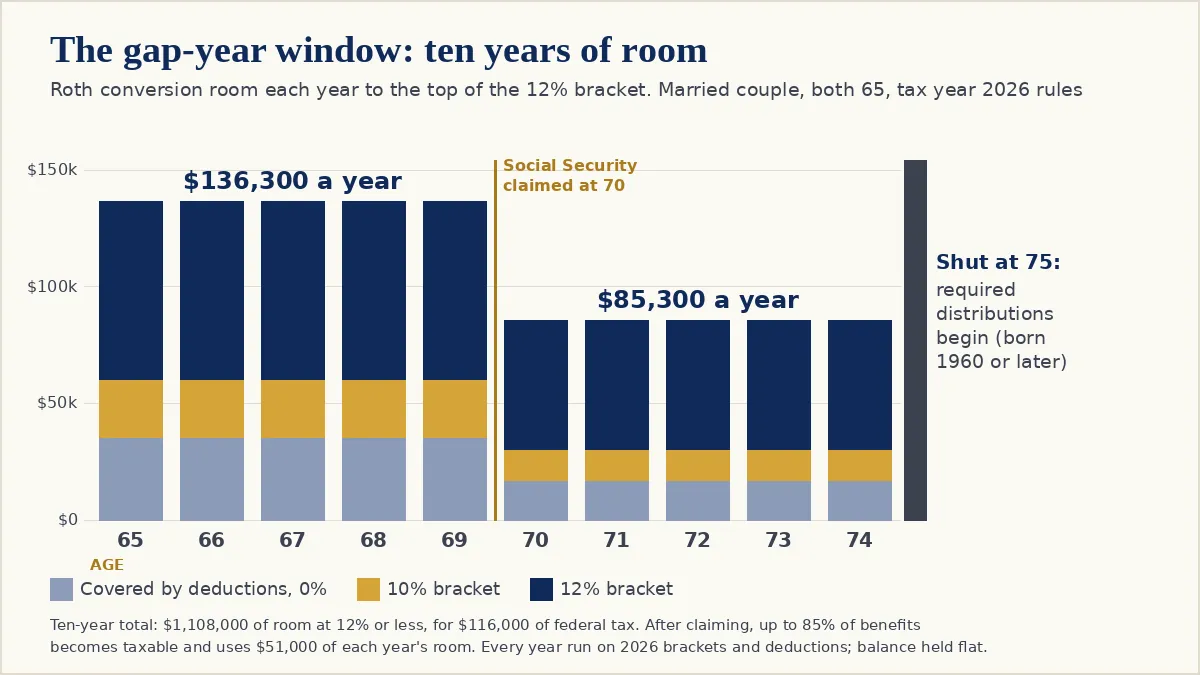
Before Social Security, ages 65 to 69. Their $12,000 of interest is covered by the $47,500 of deductions, so taxable income starts at zero.
The first $35,500 of a conversion is covered by the rest of the deductions and is taxed at nothing.
Filling the 10% bracket takes a conversion of $60,300, and the tax on it is $2,480. [1]
Filling the 12% bracket takes a conversion of $136,300. Taxable income lands exactly on $100,800 and the federal tax is $11,600 — an average of 8.5% on the amount converted. [1]
Their adjusted gross income at that point is $148,300. That matters because the $6,000 senior deduction begins to shrink above $150,000 of modified adjusted gross income on a joint return — by 6% of the excess. [4] Converting past the top of the 12% bracket runs into the 22% bracket and that phase-out at almost the same point.
Once Social Security starts, ages 70 to 74. Now $60,000 of benefits arrives every year, and every converted dollar pulls more of it into tax.
Without a conversion, only $5,000 of their benefits would be taxable. [5] Add a conversion, and by the time it reaches about $54,900 the taxable share hits the 85% ceiling — $51,000 of the $60,000. [5] From there to the top of the 12% bracket, the room left is $85,300.
The tax is the same $11,600, because taxable income ends at the same $100,800 — but it buys $51,000 less conversion, and the average cost rises to 13.6%.
Each year, 2026 rules | Room to the top of the 12% bracket | Federal tax | Average rate on the conversion |
|---|---|---|---|
Ages 65–69, before Social Security | $136,300 | $11,600 | 8.5% |
Ages 70–74, Social Security at $60,000 | $85,300 | $11,600 | 13.6% |
Difference | $51,000 less room | same |
Across the whole window, that is five years at $136,300 and five at $85,300: $1,108,000 of room at 12% or less, for $116,000 of federal tax in total — on 2026 rules, more than their entire $900,000 balance. For some households the gap years alone have room for most of the account.
Measure your own room. The Roth Conversion Explorer at Annuity HQ takes your own income and balance and shows how far a conversion can go this year before it crosses into the next bracket, and what it would cost in tax.
The trap inside the Social Security years
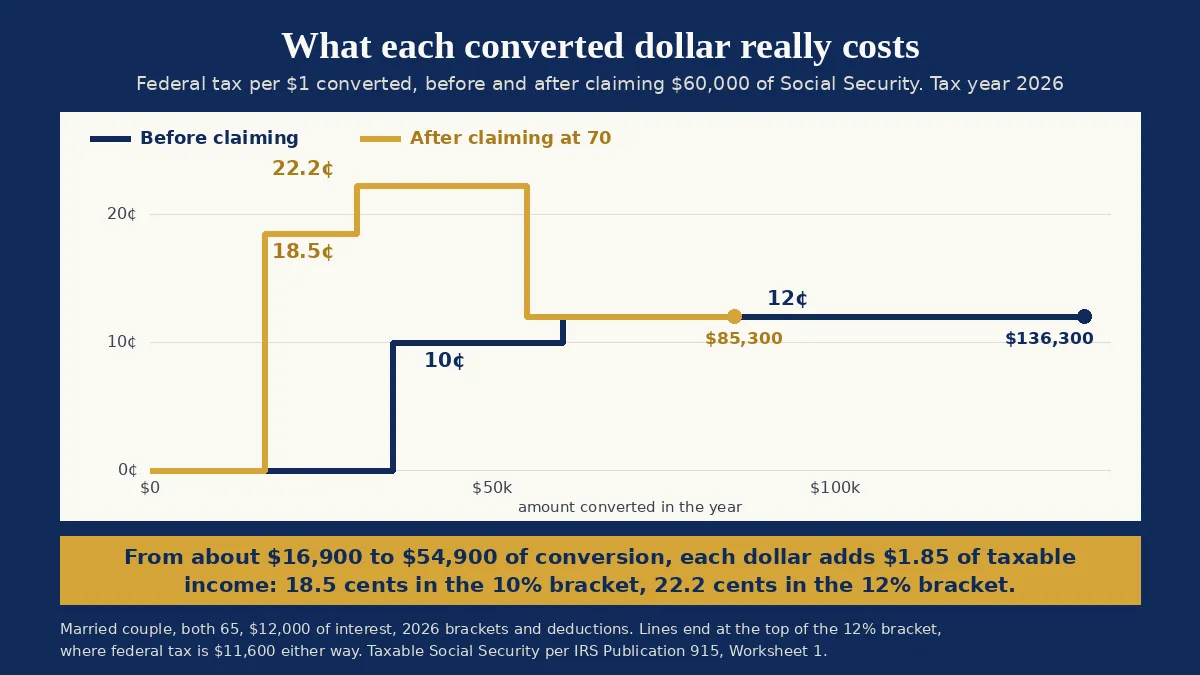
The average rate of 13.6% hides something sharper. In the stretch where each converted dollar also makes 85 cents of Social Security taxable, one dollar of conversion adds $1.85 of taxable income. [5]
Inside the 10% bracket that makes the true cost of a converted dollar 18.5 cents, and inside the 12% bracket 22.2 cents, not 12. For Tom and Linda this zone runs from a conversion of about $16,900, where their deductions run out, through the top of the 10% bracket at about $30,300, to about $54,900, where the 85% ceiling is reached. Above that, each dollar costs 12 cents again.
So the order of events matters. Before claiming, a conversion dollar in the 12% bracket costs 12 cents. After claiming, some of the same dollars cost 22.2 cents, even though the return still shows the 12% rate.
What claiming earlier does to the window. Suppose Tom and Linda claimed at 67 instead, their full retirement age. [10] Without three years of 8% delayed credits [9], their benefit would be about $48,387 a year instead of $60,000. The smaller benefit leaves more room in each Social Security year — about $95,171 — but there are eight such years instead of five.
Over the ten years, that totals about $1,033,968 of room — about $74,032 less than claiming at 70. Claiming has far larger consequences than this; the point is only that it moves the window.
Converting cheaply is only half the comparison
A low rate now is a win only against what the same dollars would cost later. The cleanest way to see it is the break-even worked through in our article on running a Roth conversion break-even: where the conversion tax is paid out of the account, growth and time cancel out, and the result turns on two rates — the one paid now and the one that would have been paid on withdrawal.
Run that per $10,000 converted at 12%. The tax is $1,200 and $8,800 lands in the Roth.
If those dollars would later be taxed at | Left in the traditional IRA, you keep | Compared with the Roth's $8,800 |
|---|---|---|
10% | $9,000 | traditional ahead by $200 |
12% | $8,800 | level |
22% | $7,800 | Roth ahead by $1,000 |
24% | $7,600 | Roth ahead by $1,200 |
A household whose required distributions will be modest, with a later rate of 10% or 12%, gains nothing from converting at 12% and loses where the conversion also pulls Social Security into tax. A household with a large balance whose distributions would later sit in the 22% or 24% bracket is in the opposite position.
The Roth also changes the later years. Original owners of a Roth IRA are not required to take distributions at any age. [7] A traditional IRA's required distribution is the prior year-end balance divided by a Uniform Lifetime Table factor — 24.6 at 75, so every $100,000 left in the account requires $4,065 to come out that year. [7]
What no one can supply is the future rate, because Congress sets the brackets. Converting in the gap years exchanges a rate you can look up today for one nobody can look up yet.
Interactions to check before converting
Medicare premiums, two years later. Tom and Linda are on Medicare from 65, and Medicare's income-related premium adjustments are set from a tax return two years old — 2026 premiums use 2024 income. [12] In the 2026 table, a joint return at or below $218,000 pays the standard Part B premium of $202.90 a month. [11] Their $148,300 sits below that line, but a larger conversion may not, and the thresholds for 2028, the year a 2026 conversion is counted, are not yet published. How the lookback works is set out in our article on Roth conversions and Medicare premiums.
Health insurance before 65. For anyone retiring earlier on Marketplace coverage, most IRA withdrawals count as income for Marketplace savings. [13] A conversion that looks cheap on the tax return can cost more through reduced premium help.
No second chances. A conversion made in a tax year beginning after 31 December 2017 cannot be recharacterized back to a traditional IRA. [8] Room has to be estimated before the year ends, and there is no undo if the estimate runs high.
State tax. Everything above is federal. States treat conversions very differently, and a move between states can change the arithmetic.
What the window cannot tell you
The example holds the account flat, runs every year through 2026 rules, and assumes Tom and Linda pay the tax from cash savings — which, as the break-even article shows, changes the answer compared with paying it from the IRA. Real balances, brackets and budgets all move.
What it does show is the size of the opportunity and when it closes: ten years, $136,300 a year before claiming and $85,300 after, shut at 75 when required distributions begin. Whether to use that room depends on a later rate no one can know, and that is each household's own judgment.
Run the window before it closes. The Roth Conversion Explorer at Annuity HQ shows what a conversion would cost at your own income this year. Run it for a year before you claim Social Security and a year after; the difference is the part of the window claiming uses up.
Frequently Asked Questions
At what age do I have to start taking money out of my IRA? It depends on your year of birth. The applicable age is 73 for people born from 1951 through 1958 and 75 for people born in 1960 or later, and the regulation reserves the rule for people born in 1959. [6] The first distribution can be delayed until April 1 of the following year. [7]
Can I convert my required minimum distribution to a Roth? No. Amounts that must be distributed for a year, including the year you reach the applicable age, cannot be converted. [8] The required amount has to come out first, and anything converted on top of it is added to income as well.
Does a Roth conversion make my Social Security taxable? It can. A conversion is income, and the worksheet the IRS uses to work out taxable benefits adds it to half of your benefits and compares the total with a $32,000 base amount for joint filers. Up to 85% of benefits can become taxable. [5] Before you claim, there is no benefit for a conversion to pull into tax.
Will a gap-year conversion raise my Medicare premiums? It can, two years later. Premium adjustments for 2026 are based on 2024 tax returns [12], and the first threshold in the 2026 table is $218,000 for a joint return. [11] Our article on Roth conversions and Medicare premiums works through it.
Source Links
All figures current for tax year 2026, checked 27 September 2026. Tax brackets, deductions, Medicare premiums and income thresholds change annually — confirm the current year's figures before applying any of this to your own return.
1. Internal Revenue Service — Tax inflation adjustments for tax year 2026 The 2026 standard deduction of $32,200 for joint filers and the 2026 joint brackets: 10% to $24,800, 12% to $100,800, 22% to $211,400.
2. Internal Revenue Service — Revenue Procedure 2025-32 Section 4.14: the 2026 additional standard deduction of $1,650 for each married taxpayer who is 65 or older.
3. Internal Revenue Service — Check your eligibility for the new enhanced deduction for seniors The $6,000 deduction for each person 65 or older, $12,000 for a couple where both qualify, effective 2025 through 2028, phasing out above $150,000 of modified adjusted gross income for joint filers.
4. Office of the Law Revision Counsel — 26 U.S.C. § 151, deduction for seniors That the $6,000 is reduced by 6% of modified adjusted gross income above $150,000 on a joint return, and applies to taxable years beginning before 1 January 2029.
5. Internal Revenue Service — Publication 915, Social Security and Equivalent Railroad Retirement Benefits Worksheet 1: half of benefits added to other income, the $32,000 base amount and $12,000 second-tier amount for joint filers, and the 50% and 85% factors with 85% of benefits as the ceiling.
6. Electronic Code of Federal Regulations — 26 CFR § 1.401(a)(9)-2 Paragraph (b)(2): applicable age 73 for people born 1 January 1951 through 31 December 1958, 75 for people born on or after 1 January 1960, and the 1959 entry reserved.
7. Internal Revenue Service — Publication 590-B, Distributions from Individual Retirement Arrangements The April 1 required beginning date; that original Roth IRA owners do not have to take distributions at any age; the Uniform Lifetime Table factor of 24.6 at 75; and the example of $100,000 ÷ 24.6 = $4,065.
8. Internal Revenue Service — Publication 590-A, Contributions to Individual Retirement Arrangements That converted amounts are included in gross income for the year of conversion; that required distributions cannot be converted; and that conversions made after 2017 cannot be recharacterized.
9. Social Security Administration — Delayed retirement credits The delayed retirement credit of 8% a year for people born in 1943 or later, and that the increase stops at 70.
10. Social Security Administration — Retirement benefits: benefit reduction for early retirement Full retirement age of 67 for people born in 1960 or later, and benefits available from 62.
11. Centers for Medicare & Medicaid Services — 2026 Medicare Parts A & B premiums and deductibles The 2026 standard Part B premium of $202.90 and the first income threshold of $218,000 for joint returns.
12. Social Security Administration — Medicare premiums: rules for higher-income beneficiaries That 2026 income-related adjustments generally use a tax return filed in 2025 for tax year 2024.
13. HealthCare.gov — What's included as income That most IRA and 401(k) withdrawals count as income for Marketplace savings.
This article is educational and is not tax, legal, investment or insurance advice. Tax rules change, apply differently in every state, and depend on individual circumstances; figures here are illustrative and current for 2026 as of the date above.
 | Jack Whittaker Jack writes the retirement education material at Annuity HQ from Mooresville, North Carolina, drawing on four decades of work with people making income, tax and Medicare decisions at retirement. |
