
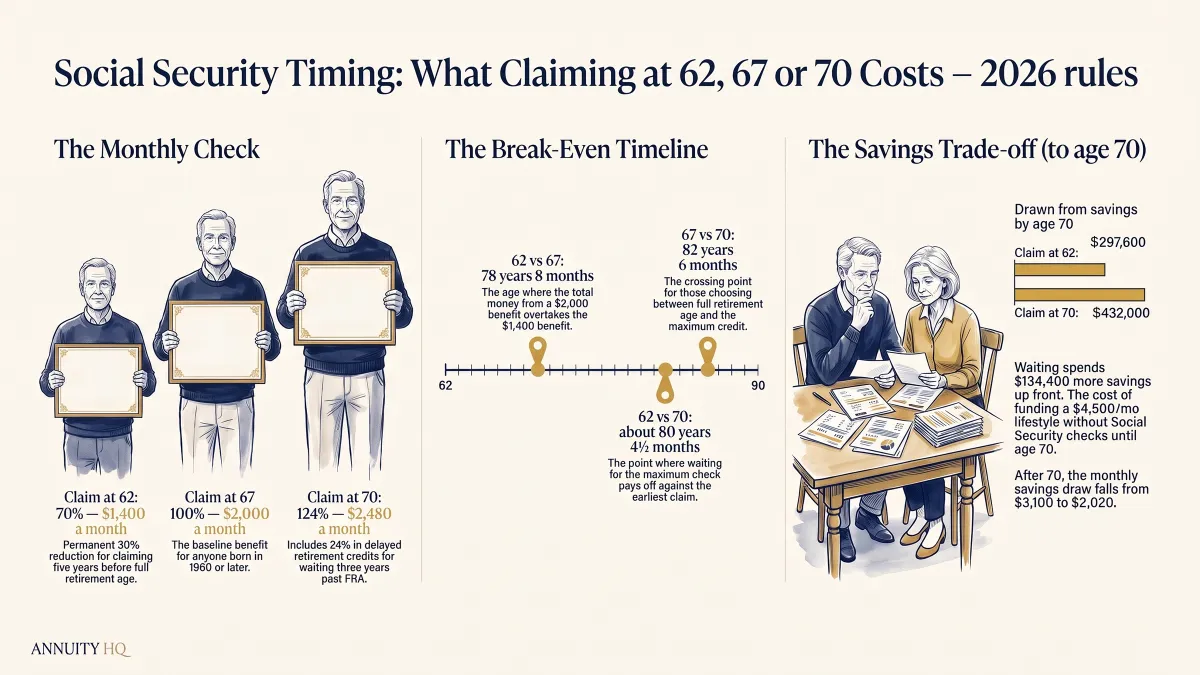
Social Security Timing: What Claiming at 62, 67 or 70 Actually Costs
Social Security advice usually arrives as a slogan. Take it early, because you never know. Wait until 70, because it is the best deal going. Both are said with total confidence, and they cannot both be right for everyone.
What sits underneath the slogans is a set of published formulas. Claim before your full retirement age and the monthly check is cut by a fixed amount for every month you are early. Claim after it and the check is raised by a fixed amount for every month you wait, up to 70.
That turns the decision into arithmetic you can check. This article works one benefit through all three ages, shows where the running totals cross, and shows what the arithmetic leaves out.
Key Takeaways
For anyone born in 1960 or later, full retirement age is 67, and claiming at 62 pays 70% of the full amount — a permanent 30% reduction. [2]
The early reduction is 5/9 of 1% for each of the first 36 months before full retirement age and 5/12 of 1% for each month beyond that. [1]
Each year of delay past full retirement age adds 8% for anyone born in 1943 or later, and the increase stops at 70, so a 1960-or-later worker who waits to 70 receives 124% of the full amount. [3] [4]
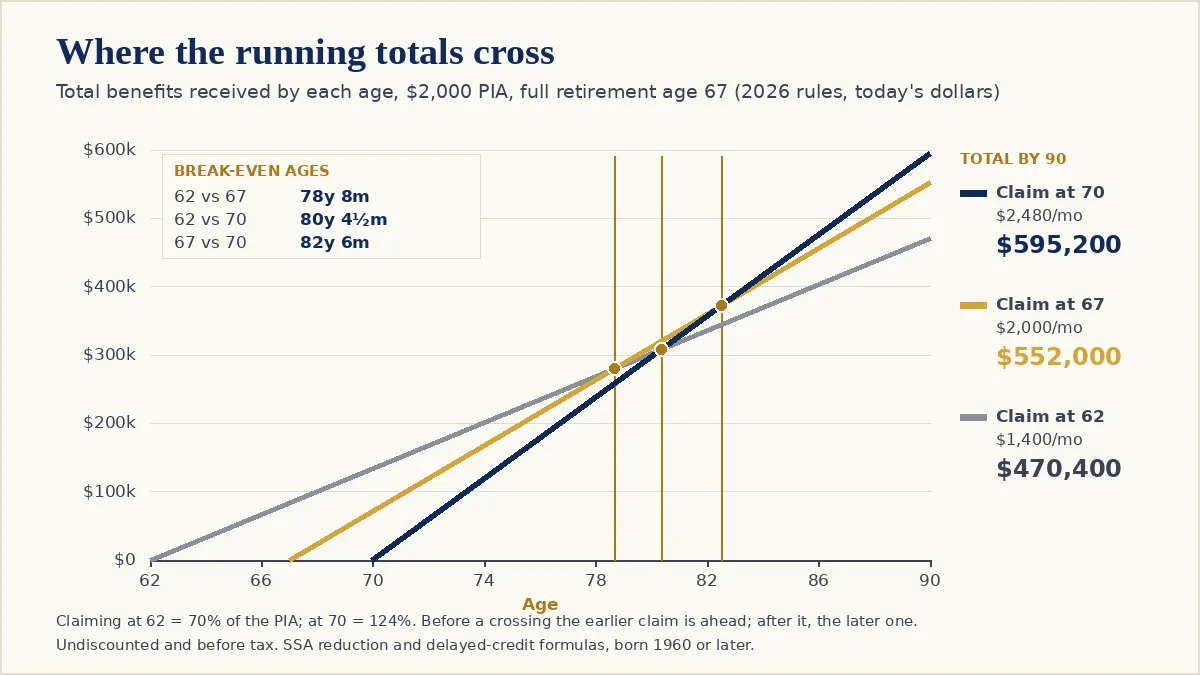
On a $2,000 full-retirement benefit, the running total from claiming at 70 overtakes the total from claiming at 62 at about age 80 and a third, and the total from claiming at 67 at age 82 and a half. Those crossing points are the break-even ages, and they move if money set aside today could have earned something.
The monthly amount the higher earner locks in carries past their own death: a widow or widower's benefit includes the delayed retirement credits the deceased had earned. [9]
How the reduction and the credits are calculated
Everything starts from your primary insurance amount, or PIA: the monthly benefit you would receive starting exactly at full retirement age. Your earnings record sets it; your claiming age decides what share of it you are paid.
For anyone born in 1960 or later, full retirement age is 67. [2] A birthday on the 1st of the month is treated as if it fell in the previous month, which matters at the edges. [2]
Before full retirement age, the benefit is reduced "5/9 of 1% per month for the first 36 months and 5/12 of 1% for each additional month." [1] Claiming at 62 with a full retirement age of 67 is 60 months early. The first 36 months cost 20 percentage points and the remaining 24 cost another 10, so the benefit is 70% of the PIA. [2]
After full retirement age, delayed retirement credits run at 2/3 of 1% a month — 8% a year — for anyone born in 1943 or later. [3] "The benefit increase stops when you reach age 70." [3] Three years of credits add 24%, so waiting to 70 pays 124% of the PIA. [4]
One timing detail: if you start before 70, some credits "will not be applied until the January after you start receiving benefits." [3]
The whole ladder, for a worker born in 1960 or later:
Claiming age | Share of the PIA | On a $2,000 PIA |
|---|---|---|
62 | 70% | $1,400 |
63 | 75% | $1,500 |
64 | 80% | $1,600 |
65 | 86⅔% | $1,733 |
66 | 93⅓% | $1,866 |
67 | 100% | $2,000 |
70 | 124% | $2,480 |
The percentages are the Social Security Administration's own table. [4] The dollar amounts at 65 and 66 are rounded down to the whole dollar, the way the agency's own 2026 benefit examples are. [14] Both the reduction and the credits are permanent — they set the monthly amount for as long as the benefit is paid.
Why the choice is really about how long the checks run
Put the ladder another way. Claiming at 70 pays 77% more a month than claiming at 62 — on the Social Security Administration's own $2,000 example, $2,480 against $1,400. [5] But the person who claims at 62 collects for eight years before the person who waits has received anything at all.
So the question is whether the bigger checks run long enough to make up for the ones never collected. That depends on something nobody knows in advance: how long you live.
The Social Security Administration's own figures give a sense of the range. Under its 2023 period life table, used in the 2026 Trustees Report, a man at 62 has a life expectancy of 20.29 years and a woman 23.08 years — roughly to 82 and 85. [8] Those are averages, and the spread around them is wide. The agency also notes that "about 1 out of every 3 65-year-olds today will live until at least age 90, and 1 out of 7 will live until at least age 95." [5]
Cost-of-living adjustments do not change the comparison. The adjustment for benefits payable in January 2026 was 2.8%. [7] Adjustments apply to the PIA from the year a worker turns 62, claimed or not [14], so every claiming age is scaled alike and the crossing points below stay put. The example uses today's dollars for that reason.
Same $2,000 benefit, claimed three ways
Take a worker born in 1964, turning 62 in 2026, whose PIA is $2,000 a month. The figures are illustrative; the rules applied to them are not.
Claim at 62: 70% of $2,000 is $1,400 a month, or $16,800 a year. [1]
Claim at 67: the full $2,000 a month, or $24,000 a year.
Claim at 70: 124% of $2,000 is $2,480 a month, or $29,760 a year. [3]
Now add up what each has received by a given birthday, before tax and in today's dollars:
By age | Claimed at 62 | Claimed at 67 | Claimed at 70 |
|---|---|---|---|
70 | $134,400 | $72,000 | $0 |
75 | $218,400 | $192,000 | $148,800 |
80 | $302,400 | $312,000 | $297,600 |
85 | $386,400 | $432,000 | $446,400 |
90 | $470,400 | $552,000 | $595,200 |
Look at the row for 80. The three totals sit within $15,000 of each other. Before it, claiming early is ahead; after it, waiting is ahead. From there, the person who waited to 70 gains another $1,080 a month on the person who claimed at 62.
The break-even ages fall straight out of the arithmetic:
62 against 67. By 67 the early claimer has banked $84,000. Waiting pays $600 a month more, which takes 140 months to make up. Break-even: 78 years and 8 months.
62 against 70. By 70 the early claimer has banked $134,400. Waiting pays $1,080 a month more, which takes about 124.4 months. Break-even: about 80 years and 4½ months.
67 against 70. By 70 the person who claimed at 67 has banked $72,000. Waiting pays $480 a month more, which takes 150 months. Break-even: 82 years and 6 months.
Set those beside the life expectancies above and neither slogan survives. The average man at 62 is expected to live about two years past the 62-against-70 crossing; the average woman, nearly five. [8] An average is not a person. Someone in poor health and someone whose parents lived to 95 are looking at the same table from opposite ends.
Put your own benefit into the gap. The Retirement Income Gap calculator at Annuity HQ takes the Social Security figure you expect and sets it against what you plan to spend. Run it once at your age-62 estimate and once at your age-70 estimate, and the difference in the monthly shortfall is the number this section is about.
The part the break-even leaves out: where the money comes from in between
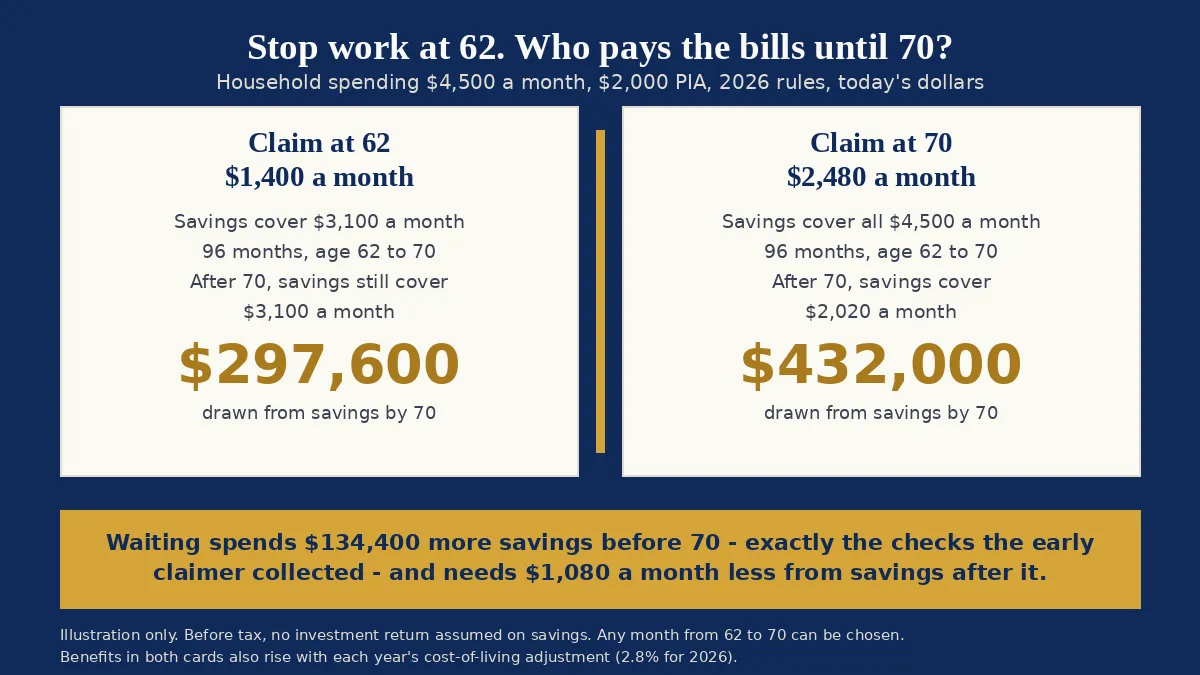
A break-even age treats the decision as a bet on longevity. For most households it is also a cash-flow question: stop working at 62 and wait until 70, and eight years of spending has to come from somewhere else.
Suppose the household above spends $4,500 a month. Claiming at 62, Social Security covers $1,400 and $3,100 a month comes from savings. Over the 96 months to 70 that draws $297,600.
Claiming at 70, nothing arrives until then, so all $4,500 comes from savings: $432,000 over the same eight years. The difference is $134,400 — exactly the benefits the early claimer collected.
What the extra $134,400 of savings buys is a smaller gap for the rest of life. After 70 the household that waited needs $2,020 a month from savings instead of $3,100 — $1,080 a month less, a shortfall about 35% smaller. That lower draw is also protected against inflation, because the benefit carries cost-of-living adjustments. [7]
That is the real trade. Waiting converts savings into a larger lifetime income. Claiming early keeps the savings in hand — for emergencies, for heirs, or for years the household may not see.
The ages are not the only options, either. Any month between 62 and 70 is available, and the table in the first section shows the in-between amounts. Nor is the decision permanent the moment it is made. An application can be withdrawn within 12 months of approval, once, provided everything received — including amounts withheld for Medicare premiums and taxes — is repaid. [12]
Discounting moves the break-even later. The running totals above treat a dollar at 80 the same as a dollar at 62. If money kept in savings would have earned something after inflation, early dollars are worth more, and the crossing points move out. Discounting later payments at a 2% real rate, the 62-against-70 break-even moves from about 80.4 to about 82.8; at 3%, to about 84.4. Those rates are illustrations, not a forecast — the point is only the direction, and that it is worth a few years.
Work, marriage and survivors
Working while claiming early. If you claim before full retirement age and keep working, the earnings test applies. In 2026 the Social Security Administration withholds $1 of benefits for every $2 earned above $24,480. In the year you reach full retirement age it withholds $1 for every $3 above $65,160, for the months before you reach it. [6]
A 63-year-old claiming $1,400 a month and earning $44,480 in 2026 is $20,000 over the lower limit, so $10,000 of benefits is withheld — the equivalent of just over seven months' checks. The money is not simply lost. "Once you reach NRA, your monthly benefit will be increased permanently to account for the months in which benefits were withheld." [6] Earnings from the month you reach full retirement age onward do not count at all. [6]
A spouse's own claim. A spousal benefit can be as much as half of the worker's PIA, and claiming it at 62 can take it as low as 32.5% of that PIA. [13] On a $2,000 PIA that is $650 a month. The spouse's own claiming age sets the spouse's reduction; it is a separate decision from the worker's.
The survivor. When one spouse dies, the survivor can receive "100 percent of the deceased worker's primary insurance amount plus any additional amount the deceased worker was entitled to because of delayed retirement credits." [10] If the worker in our example had waited to 70, a survivor at their own full retirement age could receive the full $2,480, not $2,000. [9]
The agency notes that when the higher earner delays, "it will result in higher survivor protection for your spouse." [5] For a couple, the lifespan that matters for the larger benefit is the longer of two. A survivor who claims early is reduced as well: survivor payments start at 71.5% and reach up to 100% at the survivor's own full retirement age. [11]
The claiming age also shapes the tax picture in the years before benefits start, when income can be unusually low. How those years can be used is worked through in our article on when a Roth conversion pays off.
What this example cannot tell you
It cannot tell you how long you will live, which decides the whole comparison. It leaves out income tax on benefits, which depends on your other income, and state tax, which varies by state. Your own PIA is on your Social Security statement.
What it can do is make the trade visible. Claiming early is not simply "losing" 30%, and waiting is not a guaranteed win. One gives money sooner and keeps savings in hand; the other gives more money for longer and spends savings to get there. Where the totals cross, and how far past that point you expect to live, is arithmetic you can run yourself.
Run all three ages before you pick one. The Retirement Income Gap calculator shows the shortfall between your spending and your guaranteed income. Enter your own benefit at 62, at 67 and at 70, and see how much each leaves you to cover from savings, and for how long.
Frequently Asked Questions
If I claim at 62, does my check go up when I reach full retirement age? No. The reduction is permanent — it sets the benefit for as long as it is paid. [4] Cost-of-living adjustments still apply every year. The exception is the earnings test: if benefits were withheld because you worked, the monthly amount is raised at full retirement age to credit those months. [6]
Is there any point in waiting past 70? Not for your own benefit. Delayed retirement credits stop at 70, so claiming at 71 or 72 pays the same monthly amount as claiming at 70 and forfeits the months in between. [3]
What is the break-even age for claiming at 70 instead of 62? On the arithmetic above, about 80 years and 4½ months for anyone whose full retirement age is 67, before tax and without discounting. The ratio of the two benefits is the same whatever the PIA, so the age is too. If money kept in savings could earn a real return, the break-even moves later — to around 82.8 at 2% and 84.4 at 3%.
Can I change my mind after I claim? Within 12 months of approval you can withdraw the application once, if you repay everything you and your family received, including amounts withheld for Medicare premiums and taxes. [12] You can reapply later, and the benefit is then calculated from the new starting age.
Does waiting help my spouse? It helps a surviving spouse. A widow or widower's benefit includes the delayed retirement credits the deceased worker had earned. [9] A spousal benefit while both are alive is based on up to half of the worker's PIA. [13]
I plan to keep working until 65. Does claiming early make sense? It depends on your earnings. In 2026, $1 of benefits is withheld for every $2 earned above $24,480 before the year you reach full retirement age. [6] At a high salary most or all of an early benefit can be withheld, then credited back later as a higher monthly amount.
Source Links
Figures current for 2026, checked 27 September 2026. The earnings-test limits and the cost-of-living adjustment change every year, and the life tables are revised with each Trustees Report — confirm the current figures before applying any of this to your own claim.
1. Social Security Administration — Benefit Reduction for Early Retirement The reduction: 5/9 of 1% a month for 36 months, 5/12 of 1% after.
2. Social Security Administration — Retirement benefits: Born in 1960 or later Full retirement age 67; 70% at 62; the 1st-of-the-month birthday rule.
3. Social Security Administration — Delayed Retirement Credits 8% a year (2/3 of 1% a month) for births 1943 or later; stops at 70; January application of credits.
4. Social Security Administration, Office of the Chief Actuary — Early or delayed retirement Percent of PIA by claiming age for births 1960 or later, 70% at 62 to 124% at 70.
5. Social Security Administration — When to Start Receiving Retirement Benefits (Publication 05-10147) The $1,400 / $2,480 example (about 77% more); 1 in 3 65-year-olds living to 90, 1 in 7 to 95; higher survivor protection from a delay.
6. Social Security Administration — Exempt Amounts Under the Earnings Test 2026 limits of $24,480 ($1 per $2) and $65,160 ($1 per $3); the later increase for withheld months.
7. Social Security Administration — Latest Cost-of-Living Adjustment The 2.8% increase payable from January 2026.
8. Social Security Administration, Office of the Chief Actuary — Period Life Table, 2023, as used in the 2026 Trustees Report Life expectancy at 62: 20.29 years (men), 23.08 (women).
9. Social Security Administration — Social Security Handbook § 720 A widow(er) receives the deceased spouse's delayed-retirement increase.
10. Social Security Administration — Social Security Handbook § 407, Amount of Widow(er)'s Insurance Benefit Widow(er)'s rate: 100% of the deceased's PIA plus delayed credits.
11. Social Security Administration — Survivor benefits: what you could get Survivor payments from 71.5% up to 100%.
12. Social Security Administration — Cancel your benefits application The 12-month, once-only withdrawal and full repayment.
13. Social Security Administration — Benefits for Spouses Spousal benefit up to half the worker's PIA; 32.5% at 62.
14. Social Security Administration, Office of the Chief Actuary — Social Security Retirement Benefit Calculation (workers retiring in 2026) COLAs applied to the PIA from the year of first eligibility at 62; benefits rounded down to the dollar.
This article is educational and is not tax, legal, investment or insurance advice. Social Security rules depend on individual earnings records and circumstances; figures here are illustrative and current for 2026 as of the date above.
 | Jack Whittaker Jack writes the retirement education material at Annuity HQ from Mooresville, North Carolina, drawing on four decades of work with people making income, tax and Medicare decisions at retirement. |
