
Tax Brackets in Retirement: Why Your Rate May Not Drop
Almost every piece of retirement tax planning rests on one assumption: that your tax rate will be lower once the paychecks stop. It is why people defer as much salary as they can into a 401(k), and why a Roth conversion can look like paying tax early for nothing.
For many households it holds, at least for a while. For others it holds for a few years and then quietly reverses — not because Congress changes anything, but because of how retirement income and the deductions against it are built.
This article follows one couple's own marginal rate from their last working year to 85, using only the current rules. Rates do not always rise. But the answer depends on arithmetic most people never run.
Key Takeaways
A traditional 401(k) or IRA saves tax at your working rate and charges tax at your retirement rate. Whether deferring paid off comes down to those two numbers, not to "tax-free growth."
Required minimum distributions are the prior year-end balance divided by a factor that shrinks every year — 24.6 at age 75 and 16.0 at 85, or 4.07% and 6.25% of the balance. [7]
Up to 85% of Social Security can be taxable, and the income thresholds that decide it have not changed since Congress set them in 1983 and 1993. [5] [6]
The $6,000-per-person deduction for seniors runs only from 2025 through 2028 and phases out by 6 cents per dollar of income above $150,000 for joint filers — so on a joint return where both qualify, each extra dollar can cost 12 cents of deduction. [3] [4]
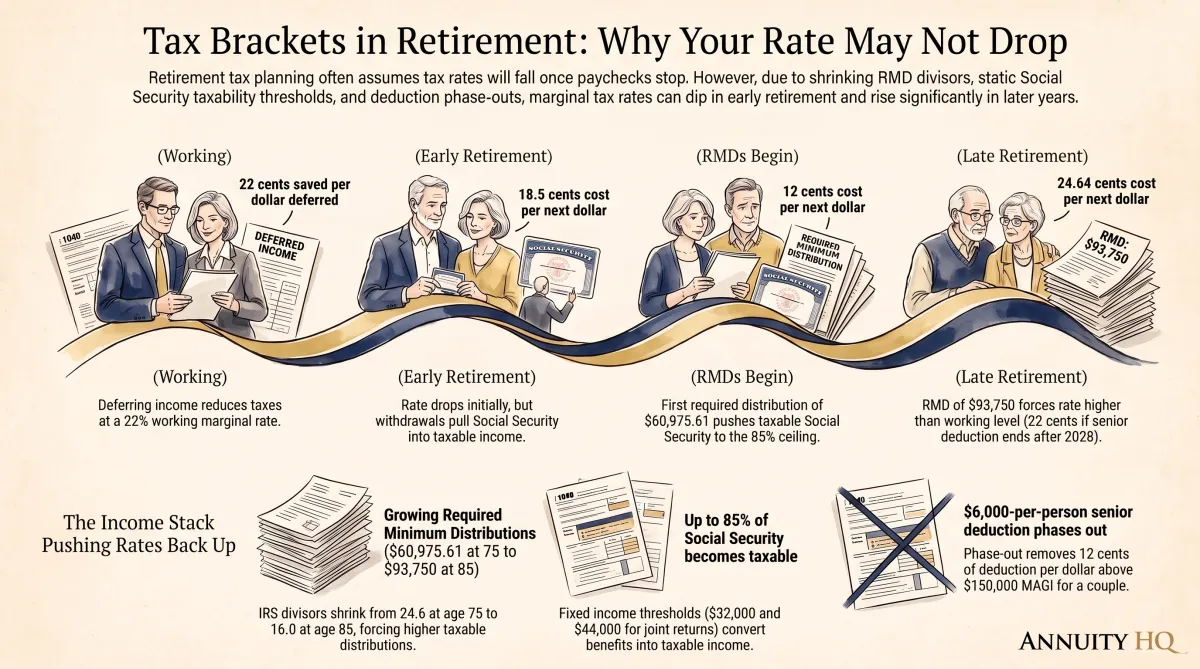
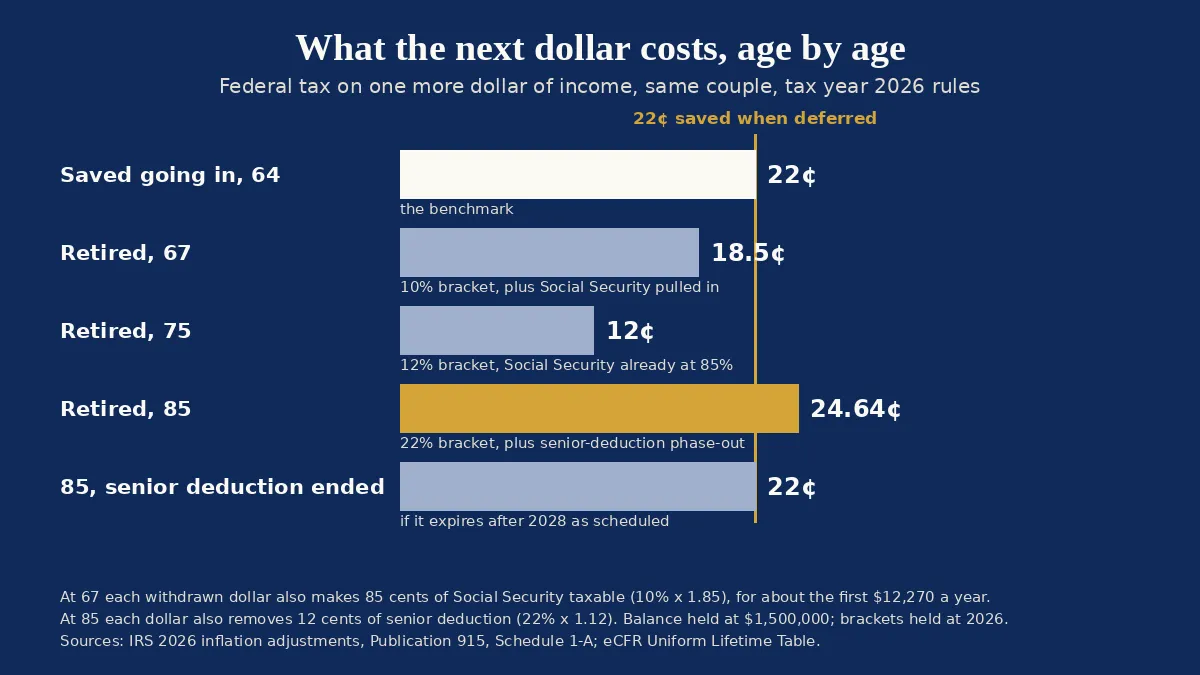
In the worked example below, a couple saves 22 cents per dollar deferred at 64. The next dollar withdrawn costs them 18.5 cents at 67, 12 cents at 75 and 24.64 cents at 85. The rate drops, then comes back above where it started.
What "your rate" actually means
Two different rates get called "your tax rate." The average rate is total tax divided by income, and it usually falls in retirement. The marginal rate is the tax on the next dollar. It is the one that matters when deciding whether to defer, withdraw or convert a dollar.
For 2026, a married couple filing jointly pays 10% on taxable income up to $24,800, 12% up to $100,800 and 22% up to $211,400. [1] The standard deduction for a joint return is $32,200. [1]
Deferring into a traditional plan is a bet on the marginal rate. Pre-tax contributions are not included in the wages reported on your W-2, so they escape tax at your working rate. [10] When the money comes out, "your withdrawals are included in taxable income" at whatever your rate is then. [9] Save at 22%, pay at 12%, and deferring won. Save at 22%, pay at 24%, and it lost. Growth multiplies both sides of that comparison equally, so it does not change which side wins.
Four things that push the rate back up
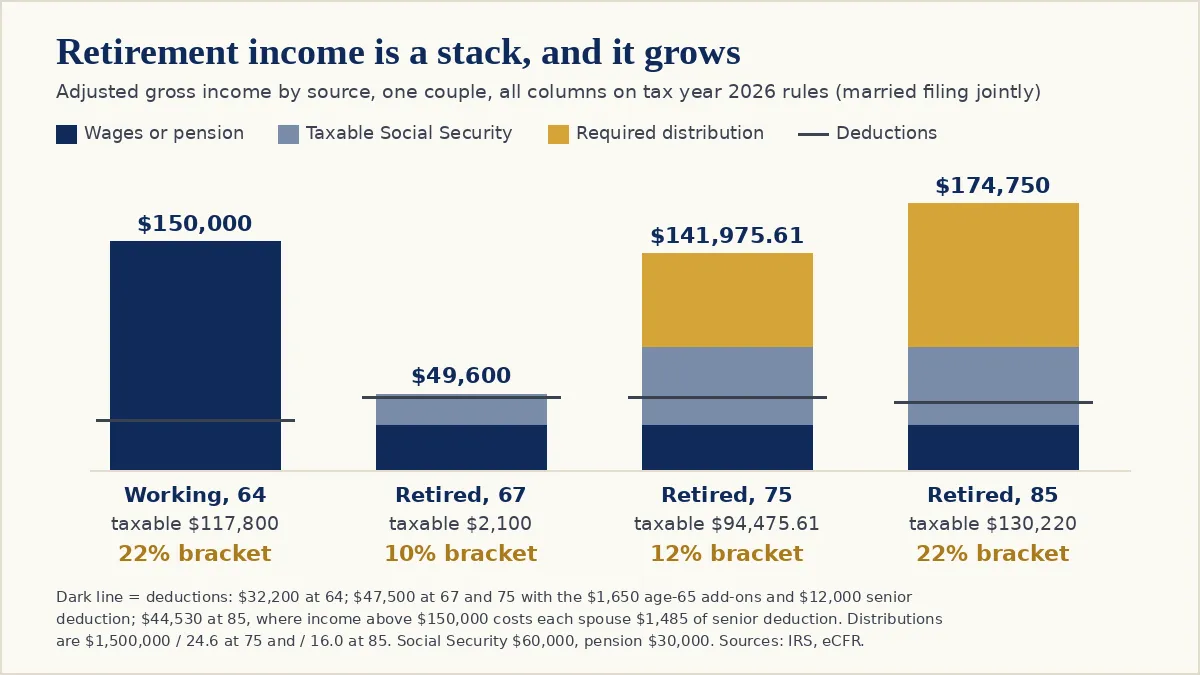
Retirement income is a stack of pieces, and several of them grow or get taxed more heavily with age while the deductions against them stay flat or shrink.
Required distributions grow as the divisor shrinks
Required minimum distributions start at the applicable age: 73 for anyone born from 1951 through 1958, and 75 for anyone born in 1960 or later. [8] Each year's amount is the prior 31 December balance divided by a factor the IRS publishes. [9]
That factor falls every year. It is 24.6 at 75 and 16.0 at 85. [7] On the same balance, the withdrawal at 85 is more than half as large again as at 75 — upward, and not optional.
Social Security becomes taxable, and the thresholds never move
For a joint return, the test adds half of the year's benefits to all other income and compares the total with $32,000. Above that, part of the benefit becomes taxable; above $44,000, up to 85% of it can be. [5]
Those thresholds "have remained unchanged since Congress first established them," in 1983 and 1993. [6] Benefits, by contrast, rise with the cost-of-living adjustment, which is 2.8% for 2026. [13] A household with a pension and a sizeable traditional account can reach the 85% ceiling as soon as required distributions start, and from then on the thresholds offer nothing back.
Pensions and annuity income are fully taxable
A pension or annuity is "fully taxable if you have no cost in the contract" — the usual case for an employer pension. [12] It sits at the bottom of the stack every year, using up the lower brackets before a dollar of IRA money arrives.
The deduction stack is flat — and part of it is temporary
A married couple both 65 or older adds $1,650 each to the standard deduction for 2026. [2] On top of that sits the enhanced deduction for seniors: $6,000 per qualifying person, $12,000 for a couple, for tax years 2025 through 2028, phasing out above $150,000 of modified adjusted gross income on a joint return. [3]
The phase-out is worked on Schedule 1-A: the income above the threshold is multiplied by 6% and subtracted from $6,000, and that result is entered once for each qualifying spouse. [4] So in the phase-out range, every extra dollar of income removes 12 cents of deduction from a couple where both qualify. And under current law the whole deduction ends after 2028. [3]
A worked example: one couple from 64 to 85
The people are invented; the rules are not. Tom and Linda are both 64 in 2026, born in 1962, so their required distributions start at 75. [8] They earn $180,000 between them and each defers $15,000 into a 401(k), inside the 2026 limit of $24,500. [11] Their pre-tax savings total $1,500,000.
In retirement they will have $60,000 a year of Social Security between them and a $30,000 pension. To keep this about the rules rather than about predictions, every column below is run through the 2026 brackets and deductions, Social Security is held in today's dollars, and the pre-tax balance is held at $1,500,000. Real brackets and balances will move; the shape is what matters.
Tax year 2026 rules, married filing jointly | Working, 64 | Retired, 67 | Retired, 75 | Retired, 85 |
|---|---|---|---|---|
Wages / pension | $180,000 | $30,000 | $30,000 | $30,000 |
Required distribution | — | — | $60,975.61 | $93,750 |
Social Security received | — | $60,000 | $60,000 | $60,000 |
Taxable Social Security | — | $19,600 | $51,000 | $51,000 |
Adjusted gross income | $150,000 | $49,600 | $141,975.61 | $174,750 |
Deductions | $32,200 | $47,500 | $47,500 | $44,530 |
Taxable income | $117,800 | $2,100 | $94,475.61 | $130,220 |
Federal income tax | $15,340 | $210 | $10,841.07 | $18,072.40 |
Marginal bracket | 22% | 10% | 12% | 22% |
Sources: brackets and standard deduction [1], age-65 add-on [2], senior deduction and phase-out [3] [4], taxable Social Security [5], and distributions. [7]
At 64, each dollar they defer saves 22 cents. The $30,000 they put away this year saves $6,600 of federal tax.
At 67, the assumption looks right. The $47,500 deduction stack absorbs almost everything; they owe $210 and sit in the 10% bracket. But the next dollar withdrawn costs 18.5 cents, not 10: it is taxed itself and pulls 85 cents of Social Security into tax with it. [5]
At 75, the first required distribution of $60,975.61 arrives — $1,500,000 divided by 24.6. [7] It pushes their taxable Social Security to the 85% ceiling of $51,000, and their taxable income to $94,475.61. That is the 12% bracket with only $6,324.39 of room left — and because Social Security is now fully counted, the next dollar costs a plain 12 cents.
At 85, the divisor is 16.0 and the distribution is $93,750. Adjusted gross income is $174,750, which is $24,750 into the senior deduction's phase-out. Each spouse loses $1,485, so the couple keeps $9,030 of the $12,000. [4] Taxable income is $130,220, the bracket is 22%, and federal tax is $18,072.40 — $2,732.40 more than in their last working year, on a gross income of $183,750, close to the $180,000 they earned at 64.
And the next dollar costs more than 22 cents. An extra $1,000 of withdrawal adds $1,000 of income and removes $120 of senior deduction, so taxable income rises by $1,120 and the tax by $246.40. The effective rate on that dollar is 24.64% — above the 22% the same dollar saved when it went in.
Run your own stack, not ours. The Roth Conversion Explorer takes your balance and your own income and shows the bracket your next dollar lands in this year. Run it as you are now and again with a larger distribution in place, and you have both ends of the comparison above.
The part that cuts the other way
That table is not an argument for converting everything. The honest reading has three parts.
The low years are real. From 67 to 74, before required distributions start, the next dollar costs this couple 18.5 cents — below the 22 cents it saved going in — for roughly the first $12,270 withdrawn in a year, and 22.2 cents after that. [5] At 75 it costs 12 cents. For much of their retirement, deferring won or came close to even.
The high years depend on the balance. Run the same couple with $400,000 of pre-tax savings instead of $1,500,000. At 85 the distribution is $25,000, taxable income is $48,350, tax is $5,306, and they remain in the 12% bracket. [1] Its bracket stays at 12% throughout. The bracket climbs back only where the pre-tax balance is large relative to the rest of the income.
That household has its own wrinkle: it sits below the 85% ceiling, so each extra dollar withdrawn still pulls 85 cents of Social Security into tax, and its next "12% bracket" dollar costs 22.2 cents. [5] Its total bill is far lower; its marginal cost is not.
The rules themselves can change. Under current law the senior deduction ends after 2028. [3] Run the age-85 column without it and taxable income is $139,250, federal tax is $20,059, and the next $1,000 costs $220 — a flat 22%, because there is no phase-out left to add to it. Congress could extend it, end it or replace it, and brackets can move either way. This article does not guess which.
"My rate will be lower in retirement" is a claim about specific years, not retirement as a whole. The same couple can be right about 67 and wrong about 85.
Where the rate question shows up in decisions
The retirement rate is the right-hand side of three choices people make long before 85.
How much to defer while working. A dollar deferred at 22% and withdrawn at 12% is a gain; the same dollar withdrawn at 24.64% is a small loss. The 2026 limit is $24,500 per person, with an $8,000 catch-up from age 50. [11]
Whether to convert in the low years. Tom and Linda's years at 67 to 74 are the gap between the paycheck and required distributions — when their taxable income is lowest. Converting some pre-tax money then means paying 18.5 to 22.2 cents per dollar, with the Social Security effect included, to reduce the balance that later generates distributions costing 24.64 cents at the margin. It also brings a tax bill forward by a decade or more, and money paid in tax today no longer works for you. Whether that suits a household depends on what its late years look like.
How the accounts are used. Roth accounts have no required distributions during the owner's lifetime. [9] That makes them a source to draw on in a year when an extra traditional dollar would land in a higher band.
Two things this example leaves out. State income tax varies widely — some states exempt retirement income, others tax it fully. And Medicare's income-related premiums use the same adjusted income, so a larger required distribution can also mean a larger premium two years later — a mechanism worked through in our article on Roth conversions and Medicare premiums.
Conclusion
The expectation that taxes fall in retirement is not wrong; it is incomplete. The first retirement years are often the lowest-taxed of an adult life. The later ones can be taxed more heavily than the working years, because required distributions rise with age, the Social Security thresholds never move, and the senior deduction phases out and, under current law, ends after 2028.
Which describes a particular household is not a matter of forecast. It is a matter of adding up the pieces. If you already know the break-even arithmetic from our article on when a Roth conversion pays off, this is where its most important input comes from: the rate you will actually pay later, for your own income, year by year.
See your own rate path. The Roth Conversion Explorer at Annuity HQ shows what a conversion would cost at your current bracket and how much room is left in it. Put that number beside the bracket your future required distributions would land in, and you are looking at the comparison this article is about.
Frequently Asked Questions
Won't I automatically be in a lower bracket once I stop working? Often at first, not always later. In the example above the couple drops from the 22% bracket to the 10% bracket at 67, then returns to 22% by 85. Whether that happens depends mostly on your pre-tax balance relative to your other income.
Why does my required distribution get bigger every year? Because it is the prior 31 December balance divided by a factor that falls with age — 24.6 at 75 and 16.0 at 85. [7] A smaller divisor means a larger share of the balance, even if the balance itself does not grow.
How much of my Social Security will be taxed? Up to 85%, depending on your combined income. For a joint return the thresholds are $32,000 and $44,000 of half your benefits plus your other income. [5] They are not adjusted for inflation, so more retirees cross them over time. [6]
Does the new $6,000 senior deduction help with this? It helps at moderate incomes, and it is available whether or not you itemize. It phases out above $150,000 of modified adjusted gross income for joint filers ($75,000 for single filers), and under current law it applies only for 2025 through 2028. [3] In the phase-out range it raises the effective rate on each extra dollar.
Does this mean I should stop contributing to my 401(k) or convert everything? This article does not say either. The comparison depends on two rates — the one you save at and the one you pay later — and the second can be lower or higher. The traditional account wins where the later rate is lower; the Roth wins where it is higher.
Source Links
All figures current for tax year 2026, checked 27 September 2026. Tax brackets, deductions, contribution limits and the cost-of-living adjustment change annually — confirm the current year's figures before applying any of this to your own return.
1. Internal Revenue Service — Tax inflation adjustments for tax year 2026 The 2026 joint-filer bands (10% to $24,800, 12% to $100,800, 22% to $211,400) and the $32,200 standard deduction for married couples filing jointly.
2. Internal Revenue Service — Revenue Procedure 2025-32 The 2026 additional standard deduction of $1,650 for each married taxpayer aged 65 or over.
3. Internal Revenue Service — Check your eligibility for the new enhanced deduction for seniors The $6,000 deduction per person ($12,000 for a qualifying couple), effective 2025 through 2028, phasing out above $75,000 of MAGI ($150,000 for joint filers), available to itemizers and non-itemizers.
4. Internal Revenue Service — Schedule 1-A (Form 1040), Additional Deductions Part V, lines 31–37: MAGI above the threshold multiplied by 6% and subtracted from $6,000, with the result entered once for each qualifying spouse.
5. Internal Revenue Service — Publication 915, Social Security and Equivalent Railroad Retirement Benefits Worksheet 1 for the taxable part of benefits: half of benefits plus other income, the $32,000 base amount and $44,000 second threshold for joint filers, and the 85% maximum.
6. Social Security Administration — Income Taxes on Social Security Benefits (Issue Paper 2015-02) That the thresholds for taxing benefits have remained unchanged since they were set by the 1983 amendments and the 1993 reconciliation act.
7. Electronic Code of Federal Regulations — 26 CFR § 1.401(a)(9)-9, Life expectancy and Uniform Lifetime tables The Uniform Lifetime Table factors of 24.6 at age 75 and 16.0 at 85.
8. Electronic Code of Federal Regulations — 26 CFR § 1.401(a)(9)-2 The applicable age: 73 for anyone born 1951 through 1958, and 75 for anyone born in 1960 or later.
9. Internal Revenue Service — Retirement plan and IRA required minimum distributions FAQs That each minimum is the prior 31 December balance divided by a published life expectancy factor; that withdrawals are included in taxable income except for basis; and that Roth IRAs have no required distributions during the owner's life.
10. Internal Revenue Service — Topic no. 424, 401(k) plans That elective deferrals are not subject to income tax withholding when deferred and are not included in box 1 wages on Form W-2.
11. Internal Revenue Service — 401(k) limit increases to $24,500 for 2026, IRA limit increases to $7,500 The 2026 elective deferral limit of $24,500 and the $8,000 catch-up for employees aged 50 and over.
12. Internal Revenue Service — Publication 575, Pension and Annuity Income That pension and annuity payments are fully taxable where the recipient has no cost in the contract.
13. Social Security Administration — 2026 Cost-of-Living Adjustment fact sheet The 2.8% cost-of-living adjustment to Social Security benefits for 2026.
This article is educational and is not tax, legal, investment or insurance advice. Tax rules change, apply differently in every state, and depend on individual circumstances; figures here are illustrative and current for 2026 as of the date above.
 | Jack Whittaker Jack writes the retirement education material at Annuity HQ from Mooresville, North Carolina, drawing on four decades of work with people making income, tax and Medicare decisions at retirement. |
